Gripping tightly to thoughts, emotions, or even the need to manage every minute detail. It’s something I notice everywhere. Feeling controlled by the mind’s loops and persistent worries can honestly feel exhausting.
If you’ve ever wondered why freedom or ease seems out of reach no matter how hard you try to let go, you’re definitely not alone.
The ancient spiritual tradition of Vedanta brings a unique and, I think, really refreshing perspective on all of this. Practicing Vedanta letting go isn’t about more striving or battling with your own headspace. It’s about uncovering a freedom that’s already part of your deepest nature.

The Ancient Art of Letting Go
Mental clutter, emotional waves, the urge to control situations. These are just some of the things I’ve repeatedly seen people struggle with.
Modern approaches to letting go, like positive thinking or basic mindfulness, tend to focus on techniques to “move past” thoughts or train yourself to relax. They’re pretty useful, but there’s usually still a subtle sense of effort and resistance underneath.
Vedanta, with its roots stretching back to the earliest Upanishads, stands out because it isn’t just a self-improvement method or a quick stress fix.
What really sets it apart for me is how the idea of letting go is built on realizing and resting as the unchanging, spacious awareness that’s already present within you.
Instead of pushing thoughts or feelings away, practicing how to practice Vedanta letting go means recognizing that the true “you” (consciousness itself) remains untouched, calm, and free behind everything that happens in your mind or life.
There’s nothing to strain for.
Just a gentle, ongoing process of remembering who and what you really are.
What Vedanta Really Means by Letting Go
Letting go in Vedanta isn’t about suppressing feelings or pretending things don’t matter.
I know it can sound confusing at first because so many spiritual or self-help approaches talk about detachment in ways that seem cold or distant.
In Vedanta, it’s different.
Here, true letting go comes from a shift in identity. Instead of “I am angry” or “I am anxious,” there’s a quiet recognition: “I notice anger,” “I notice anxiety.”
The sense of “I am” gently moves back into spacious, witnessing awareness.
I really like how Ramana Maharshi, one of the greatest 20th century Vedanta teachers, described this. When someone asked him how to let go of attachment or suffering, his advice usually revolved around understanding.
It’s enough to see that thoughts and emotions pass, but the awareness witnessing them stays.
You’re not pushing anything out. You’re simply recognizing the always-present background of awareness.
The more I’ve practiced this, the less I feel yanked around by thoughts or old habits.
In modern mindfulness, the focus is often on accepting what arises, being present, or returning to the breath. While that can calm things down, Vedanta letting go goes deeper.
The insight isn’t just about being okay with what’s here.
It’s about stumbling upon the truth that what you are, as pure awareness, doesn’t actually cling or resist anything in the first place.
The struggle drops away not because you succeeded in “letting go,” but because you realized that pure awareness, the Self, is always already free.
The mind, no matter what it’s up to, doesn’t change that.
For a practical demonstration and deeper understanding of Ramana Maharshi’s self-inquiry, watch this short video:
How to Practice Vedanta Letting Go
When I first tried switching my practice from effortful “letting go” to this deeper Vedantic approach, it honestly felt strange.
It’s not about wrestling the mind into silence.
Here’s how to practice Vedanta letting go in a way that’s both practical and true to the tradition:
Notice what the mind clings to. Maybe it’s a stressful thought, resentment, an old fear, or even just a story about how things “should be.”
Take a moment to pause and simply become aware of what’s happening. Don’t try to push it away. Just notice the pull or push.
Ask, “Who is attached?” This question isn’t about analyzing or mentally figuring things out. It points attention back to the awareness that’s watching the whole show.
Is the thought itself upset, or is there a quiet witnessing that’s actually unaffected?
Ramana Maharshi called this self-inquiry. When I do this, I sometimes feel an immediate softening, a loosening of the old grip.
Rest as the witness. Instead of jumping into the mental drama, simply notice: “Here is a thought. Here is a feeling.”
Watch it like watching clouds drift by. Awareness itself feels vast, open, and still.
Let yourself just rest there, even for a few seconds.
Return to awareness whenever you get snagged. The mind is really good at reidentifying with its stories or worries.
When you notice this, don’t scold yourself. Just gently bring attention back to that space of awareness.
It’s not about being perfect. It’s a process of remembering, again and again.
This is a gentle practice. It’s about warmth and patience, not yet another thing to do or get right.
Over time, I’ve noticed that clinging happens less and less.
When I do get caught up, coming back to awareness gets easier and more natural.
Best Vedanta Letting Go Techniques
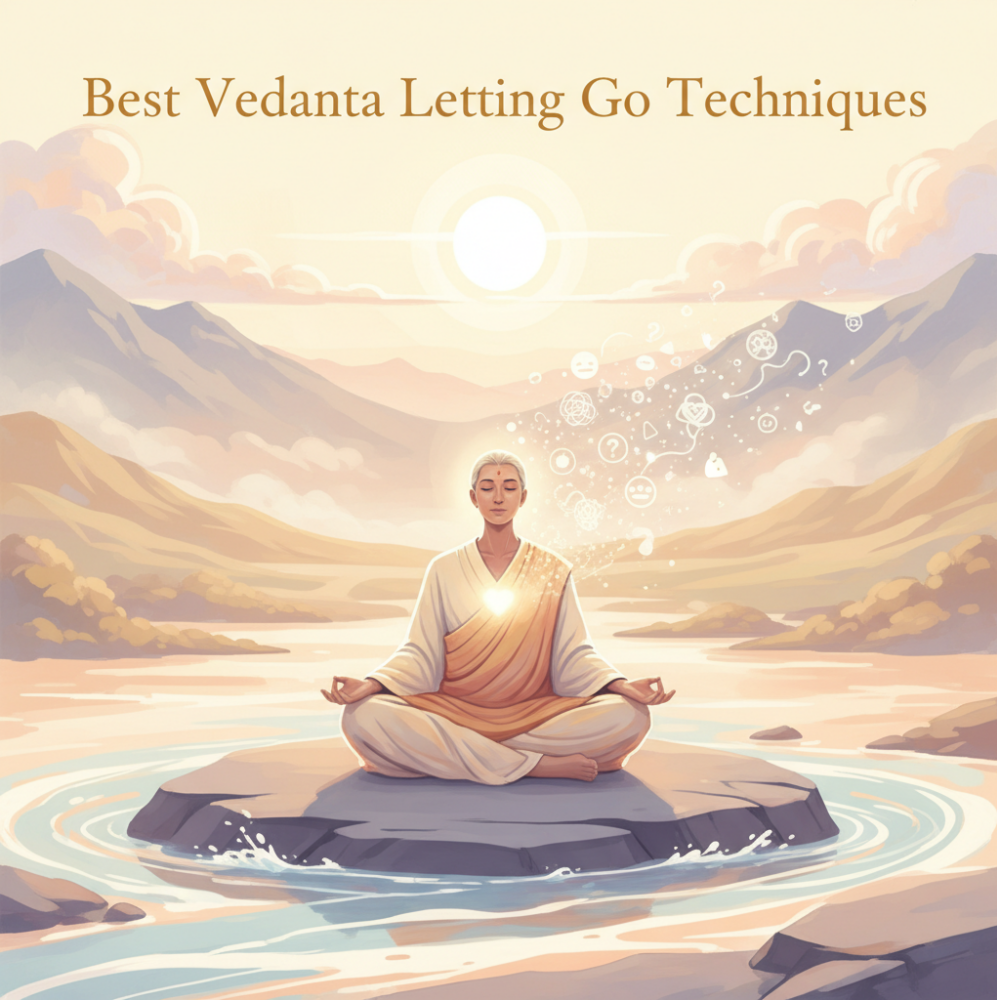
Some classic practices from the Vedanta tradition can help you move beyond the mind’s patterns and reestablish your identity as that spacious awareness.
Here are my favorite best Vedanta letting go techniques:
Neti Neti (“Not This, Not This”): I love how simple and direct this is.
Whenever a thought, feeling, or identity pops up (like “I am anxious, I am angry, I am tired”), remind yourself: Not this, not this.
Whatever can be seen or felt isn’t the real “I.” Awareness is the only thing that can’t be seen, named, or lost.
Gently, you peel away layer after layer of false self.
Witness Meditation (Sakshi Bhava): This practice is about quietly observing, without interference, the stream of experiences passing by.
Thoughts rise, sensations move, moods flicker, but you keep noticing, “I am the one aware of all of these.”
This isn’t passive. It’s actually a very alive, grounded seeing.
Over time, experiences come and go more freely because you’re not stuck inside them.
Surrender to Brahman: In Vedanta, Brahman is the name for the absolute, the universal intelligence or presence behind everything.
Surrender here isn’t about giving up. It’s choosing to stop trying to control everything mentally.
When I feel tight or overwhelmed, sometimes I mentally say, “I leave this in the hands of the infinite.”
It brings a sense of softness, trust, and ease.
Some modern teachers, like Eckhart Tolle, echo these same insights in language that’s really approachable.
Tolle’s focus on presence, witnessing thoughts, and total acceptance of the moment dovetails beautifully with classical Vedantic letting go.
The real learning, I’ve found, comes from doing. Trying these best Vedanta letting go techniques when daily life gets tough.
Vedanta Letting Go Meditation
When I first began meditating, most methods asked me to concentrate, visualize, or repeat something. I had good results, but I often felt drained or restless.
Vedanta letting go meditation feels different.
The whole point is to recognize, again and again, that you are not your mind’s contents.
Meditation becomes resting as awareness itself, not manipulating thoughts or chasing bliss.
That realization alone changes everything.
Try this simple Vedantic meditation:
Find a comfortable, quiet place to sit. Let your posture be relaxed but awake.
Close your eyes. Notice any sounds, bodily sensations, or thoughts.
Instead of engaging, just watch them like someone casually noticing birds outside a window.
If a strong thought grabs your attention, notice the awareness that’s observing it. Ask, “What is it that knows this experience?”
Stay focused on this sense of being the observer. Thoughts, feelings, and sensations can come and go.
The observer, your real nature, remains calm and stable in the background.
See if you can rest here for five or ten minutes. When the mind wanders, just return to noticing awareness itself.
I try to do this kind of meditation daily, even if just for a few minutes.
The best part is you don’t need to force silence. Whatever is happening is welcome.
Over time, the urge to change or cling to experience fades a bit, replaced by a deep sense of stillness and freedom.
Vedanta Letting Go Practices in Daily Life
The biggest changes I’ve seen came not just in meditation, but in how I live, work, and relate to others.
Vedanta letting go practices are realistic. They’re not just for yogis in caves.
They work during a heated meeting, a rough day with family, or when I’m hit with a wave of self-doubt.
During stress or anger: When frustration flares up (and, trust me, it does), I pause and notice the feeling fully.
Then I ask, “Who is feeling this?”
Immediately, the energy shifts. Even if the feeling stays, I’m no longer drowning in it.
Awareness feels like safe ground under my feet.
In relationships: I used to replay conversations in my head, trying to control outcomes or replay past hurts.
Now, if a story gets stuck, I bring in Neti Neti and remind myself, “These thoughts aren’t me.”
Then, if needed, I surrender to the moment, to love, to whatever Life brings.
With decisions: If I feel anxious about choices, instead of going into analysis mode, I step back, rest as awareness, and see what feels intuitively right from that space.
Often, clarity comes when I’ve let go of controlling the answer.
Practicing true freedom beyond the mind means remembering your deepest nature, again and again.
Over time, the identification with passing thoughts fades, and real letting go happens spontaneously.
You don’t force release. You see that what you thought you were holding isn’t even something you need to carry at all.
Letting Go vs. Detachment – The Common Confusion

This is a spot I tripped up a lot early on.
Detachment and letting go might sound similar, but they’re pretty different once you feel your way into it.
Detachment, as it’s sometimes misunderstood, can seem like emotional numbness or suppressing how you feel.
That kind of stiff upper lip isn’t what Vedanta points to at all.
True letting go in Vedanta comes from clear seeing.
When you rest as awareness, you’re actually more alive, more present, and often more caring.
Emotions are still felt, sometimes even more deeply, but you don’t claim ownership or let your identity get twisted into the story.
It’s not about shutting down. It’s about seeing clearly, allowing everything, and resting in the unchanging part of yourself.
As Ramana Maharshi put it, “Non-attachment does not mean indifference.”
Love, compassion, and engaged living all continue (and often deepen) when you see from the bigger perspective of awareness.
I’ve found I’m more able to show up for others and myself with a sense of warmth and understanding, without getting stuck in mental drama.
The Freedom of Being – Closing Reflection
The heart of all Vedanta letting go practices, techniques, and meditations is pretty simple: the freedom you seek is already within you.
The more you see that awareness itself isn’t bound or broken, the less you feel trapped by what’s happening in your mind or circumstances.
What I tried so hard to let go of was never truly “mine” to hold in the first place.
It just felt that way until I paused, looked, and remembered.
I’ll leave you with one of Ramana Maharshi’s direct reminders: “Your own Self-Realization is the greatest service you can render the world.”
That’s how I see letting go in action. Not abandoning the world, but living from a place of deep, open freedom.
If you’re curious to go deeper, check out articles like Presence vs. Mindfulness – What’s the Real Difference?, How to Stay Present in Everyday Life, or What Is the Pain-Body? on DailySelfWisdom.com.
I’d also recommend picking up Eckhart Tolle’s The Power of Now or Stillness Speaks. Both echo Vedanta’s heart wisdom beautifully and offer lots of practical help for daily life.
As always, your real guide is your own awareness and lived experience.
Thanks for reading, and I hope your path feels a little lighter and more open today.

Chris is the voice behind Daily Self Wisdom—a site dedicated to practical spirituality and inner clarity. Drawing from teachings like Eckhart Tolle, Ramana Maharshi, and timeless mindfulness traditions, he shares tools to help others live more consciously, one moment at a time.Learn more about Chris →
Leave a Reply