You reread the same paragraph for the third time. The sentence hasn’t changed, but something in your ability to take it in clearly has. Maybe you catch yourself making a mistake you would normally never make: sending an email to the wrong person, mistyping a figure you have entered a hundred times before, forgetting why you walked into a room.
The natural response, for most of us, is to push through. One more email. One more task. One more hour, and then we’ll stop.
This is the paradox worth sitting with. The harder we try to produce more by working without pause, the more the quality of our attention, judgment, and creativity tends to erode.
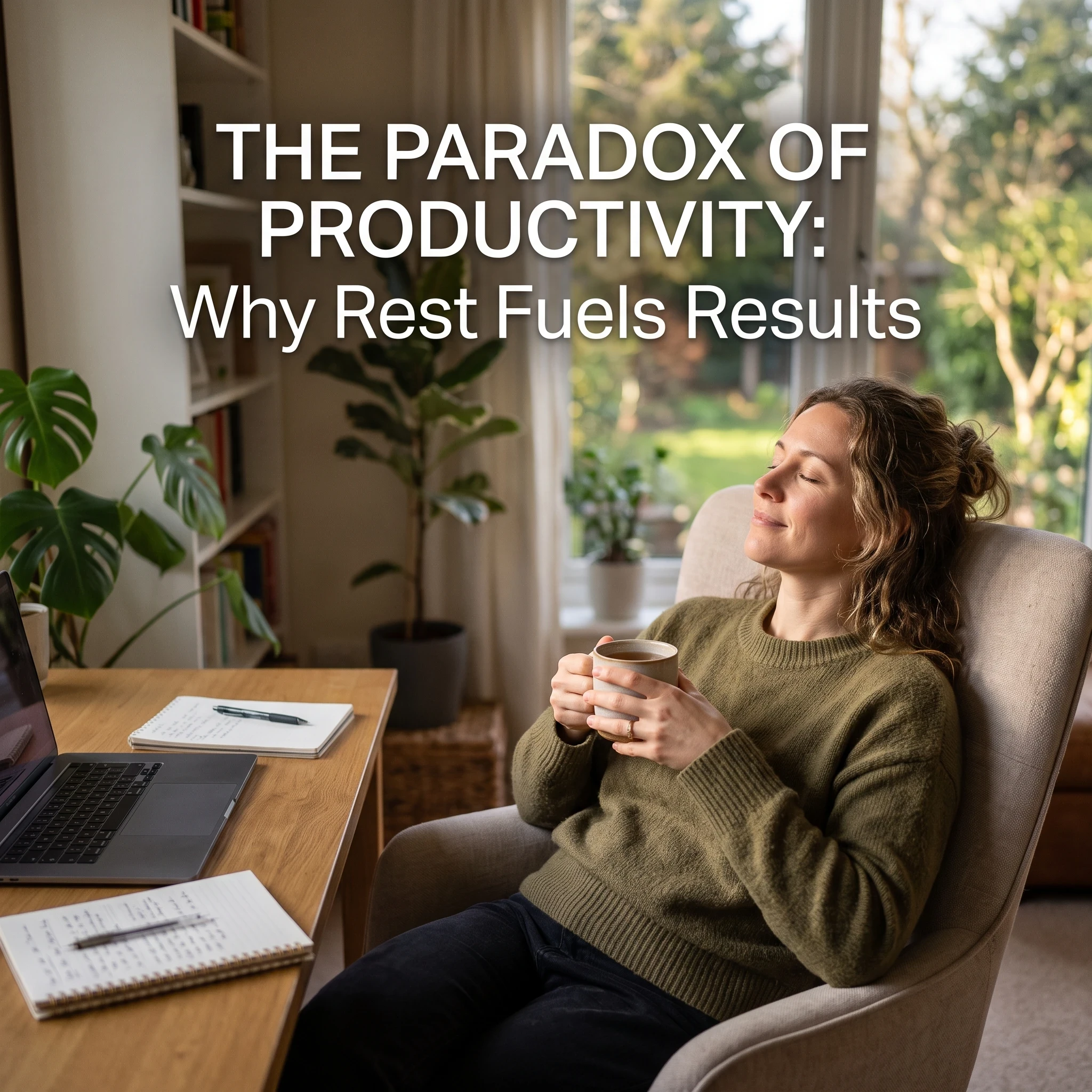
Rest and productivity are not opposites competing for the same hours in a day. They belong to the same cycle, and separating them is a large part of what causes the strain so many people associate with modern work.
The Productivity Trap
Working longer hours feels like the obvious way to get ahead, especially when a deadline is close or a list of tasks refuses to shrink. But effort does not scale in a straight line forever. Past a certain point, additional hours stop adding much value and start subtracting it.
Fatigue is not simply the sensation of being tired. Over time it narrows attention, makes distractions harder to filter out, and slows the flexible thinking that good decisions require.
Small errors creep in. Tasks that would normally take a few minutes start to feel disproportionately difficult. Patience shortens, and frustration surfaces more quickly than it otherwise would.
Hustle culture tends to treat this pattern as something to override through willpower: the person who stays latest, who answers messages after midnight, who treats exhaustion as evidence of commitment.
But cognitive performance does not follow a culture’s preferences. It follows cycles of exertion and recovery, and when recovery is repeatedly skipped, the work itself begins to suffer, regardless of how much someone cares about it.
What Rest Actually Does in the Brain
Rest is not only what happens during sleep, though sleep remains essential to nearly everything discussed here. Waking rest, whether a walk, an unstructured pause, or simply stopping to look out a window, changes what the brain is doing, even when nothing about the body looks particularly active.
During sleep, and to some extent during quiet waking moments, the brain works on consolidating memory: strengthening some traces, letting others fade, and integrating new information with what is already known.
Attention also recovers during rest. Sustained focus draws on a limited resource, and brief breaks appear to allow that resource to partially replenish, which is part of why concentration is easier to sustain across a day built around intervals rather than one continuous push.
Emotional regulation benefits as well. Fatigue makes it harder to meet frustration, disappointment, or uncertainty with any steadiness, and adequate rest supports the composure that difficult days require.
One structure worth understanding more precisely is the default mode network, a set of brain regions that becomes more active when attention is not locked onto an external task.
It is associated with internally directed thought: autobiographical memory, imagining future scenarios, and forming loose associations between ideas that were not consciously connected before.
This is one plausible reason solutions to a stuck problem sometimes surface on a walk rather than at a desk. When focused attention loosens, the mind is freer to draw connections it would otherwise set aside in favor of the task at hand.
None of this means every form of inactivity is restorative, or that the brain automatically resets the moment work stops. Quality matters. A break spent quietly worrying about everything left undone will not do the same work as a break spent in genuine rest.
Real Rest Versus Stimulation
It is worth distinguishing between rest and stimulation, because the two are often mistaken for each other. Scrolling a feed, switching between shows, or refreshing an inbox can feel like a break because it is different from the work you just stepped away from.
But if your attention is still being captured, redirected, and held by a stream of new information, your mind has not actually been given room to settle. It has simply changed which task it is doing.
This is not a claim that technology is inherently harmful, or that a screen can never be part of genuine rest. The distinction is not the device; it is whether attention is allowed to loosen or whether it stays held taut by novelty and interruption.
Recognizing what kind of rest you actually need is usually more useful than following a generic list of recovery activities. Physical fatigue calls for something different than mental overload. A day spent making decisions benefits from stepping away from further decisions, not from consuming more information.
Emotional depletion, the kind that comes from managing other people’s needs or difficult conversations, is eased by solitude or honest connection with someone you trust rather than by distraction.
Overstimulation is addressed by turning things down: less sound, less light, fewer demands on the senses.
A creative block often responds better to input that carries no obligation to produce something, such as music or unhurried time outdoors, than to another attempt at forcing the work. And some depletion is simply asking for stillness, a few minutes with no agenda, where nothing needs to be figured out.
Learning to notice which of these you are experiencing, rather than defaulting to the same habit every time, is a skill that develops with practice.
Ancient Wisdom on Effort
The relationship between action and rest was examined by contemplative traditions long before productivity became a subject of research. These traditions differ from one another in important ways, and it does the ideas a disservice to flatten them into a single technique. Still, several strands share an underlying insight worth taking seriously.
Taoist philosophy describes wu wei, often translated as effortless action or non-forcing. This does not mean passivity. It describes a way of acting that works with the natural shape of a situation rather than against it, doing what is needed without adding unnecessary strain or resistance. Wu wei has more to do with skillful timing than with doing nothing.
In the Bhagavad Gita, Krishna’s counsel to Arjuna centers on performing right action without being psychologically bound to its results. This is a distinction between the action itself and one’s attachment to a particular outcome, not a technique for calming anxious thoughts.
A person practicing this kind of detachment may well experience greater steadiness as a byproduct. But the teaching concerns the nature of action and desire more broadly, and reducing it to a stress-management tool understates what it actually asks of a person.
Zen traditions emphasize simplicity and full presence: clearing away what is unnecessary, giving complete attention to the task in front of you, and working from stillness rather than urgency.
Across many traditions, from monastic retreat to the Sabbath, there is a recurring structural insight that a life needs designated time apart from productive effort, not only as recovery for the sake of future output, but as something valuable in its own right.
These traditions do not teach identical things, and they emerge from very different worldviews. What they share is a recognition that action driven by fear, compulsion, ego, or constant urgency tends to be less intelligent, and often less effective, than action that comes from a place of steadiness.
Rest Guilt and Hustle Culture

Even people who are visibly exhausted often find rest uncomfortable, and the reasons run deeper than a simple lack of time. For many, self-worth has become closely tied to achievement: how much gets done, how full a calendar looks, how needed a person appears to be. Inside that framework, slowing down can register less like recovery and more like a threat to one’s sense of value.
Busyness has also become a kind of social currency, a visible signal of importance or relevance. Falling behind, or being seen to have nothing urgent to do, can trigger a real fear of becoming dispensable. Workplace norms often reinforce this directly, rewarding constant availability and treating rest as something that must be justified or hidden.
There is also a quieter, more internal obstacle: many people find it genuinely uncomfortable to be alone with their own thoughts once the noise of tasks and notifications falls away. Rest can surface feelings or questions that busyness had been keeping at bay, which is part of why some people fill every open moment rather than sit inside it.
Rest guilt does not always look like refusing to stop working. Often the body stops while the mind keeps going: replaying a conversation, planning tomorrow’s tasks, rehearsing an apology, worrying about something left undone.
This is a form of continued labor even when nothing productive is happening, and it prevents the kind of recovery that unoccupied time is meant to provide.
None of this is simply a matter of personal discipline. Workloads, financial pressure, caregiving responsibilities, and workplace expectations genuinely limit how much rest many people can take, regardless of how well they understand its value. Naming that constraint honestly matters more than suggesting rest is a decision anyone can simply choose to make more of.
Rest, Avoidance, and Knowing the Difference
It is not always easy to tell the difference between needing rest and avoiding something uncomfortable, and the two can look identical from the outside. The distinction has less to do with what you are doing and more to do with what it leaves you with afterward.
Rest is intentional recovery. It tends to leave you a little clearer, a little steadier, more able to return to what you had stepped away from.
Avoidance postpones something rather than resolving it. It can offer temporary relief from discomfort, but it does not restore clarity, and the postponed task or feeling is usually still waiting, sometimes with added weight, when you come back to it.
This is not a question of character. Numbing out for an afternoon does not mean someone is lazy; it usually means something felt too heavy to face directly in that moment.
The more useful question is simply how you feel afterward. If a break leaves you foggier, more tense, or quietly aware that the underlying issue has grown, that is worth noticing without judgment. If it leaves you a bit lighter and more able to engage, that is closer to genuine rest.
Approaching this with curiosity rather than self-criticism tends to produce more honest answers than approaching it as a test to pass or fail.
Bringing Rest Into an Ordinary Day
There is no single formula for building rest into a life, because work, health, responsibilities, and energy differ too much from one person to the next. A few patterns, though, tend to help most people, adapted to fit their own circumstances rather than followed as a rigid system.
• Step away before attention fully collapses, rather than after concentration is already gone.
• Protect sleep, even when it means letting other things go undone.
• End the workday at a set time when that is possible, so the mind gets a clear signal that effort has closed.
• Take a walk without a podcast or a phone, so attention has somewhere to loosen.
• Alternate demanding tasks with lighter ones instead of moving from one hard project straight into the next.
• Build in periods without notifications, and allow some unstructured time with no goal attached.
How much of this is realistic depends on circumstances. A demanding job, caregiving responsibilities, financial pressure, or a health condition can limit how much control someone has over their schedule, so these ideas should be adapted rather than treated as a checklist to complete perfectly.
None of this needs to become another system to optimize or another standard to fall short of. The point is closer to attentiveness: noticing what your particular day and body actually need, and responding to that rather than to a general idea of what rest is supposed to look like.
The Deeper Paradox
Everything discussed so far supports a fairly practical claim: rest improves the quality of work. That claim is true, and it is also incomplete, because it keeps rest tethered to output as its justification.
If rest matters only because it makes someone more productive, it is still operating inside the same framework that caused the exhaustion in the first place, one where nothing has value unless it produces something measurable.
A walk does not need to generate an idea to be worthwhile. Sleep does not need to be justified by the efficiency it produces the next day. Sitting quietly for ten minutes does not need to become a technique for better focus later.
These things are also simply part of what it means to be a living person, with a body and a mind that require rest independent of what that rest goes on to enable.
Human worth is not fully captured by output, however easy it is to slip into measuring it that way.
A person who rests, reads for pleasure, sits outside without a purpose, or does nothing in particular for an afternoon has not failed to be productive. They have simply lived a portion of their life the way a life is meant to be lived, some of it useful and some of it simply their own.
This is a harder idea to sit with than the claim that rest makes you more effective, because it asks for less justification, not more. But it is closer to the truth.
Rest Is Part of the Rhythm
Sustainable work is not a straight line pushed further and further outward. It moves in a rhythm: attention, effort, release, recovery, and return.
Rest supports better work, and that is worth remembering on days when slowing down feels indulgent or inconvenient. But rest does not only exist to make you more productive. It is also simply part of what a full life includes, useful and unmeasured at once.
Slowing down physically does not always quiet the activity of the mind. You may stop working while your thoughts continue planning, worrying, or replaying the day.
For practical ways to step out of that cycle, read How to Feel Calm and Free When Your Mind Won’t Slow Down.
If you would prefer a more structured approach to managing everyday stress, anxiety, and mental noise, read my Calm and Free Program review to see what the course includes and whether it may be suitable for you.
Frequently Asked Questions
Why is rest important for productivity?
Rest allows the mind and body to recover, consolidate memory, and restore the kind of attention that focused work requires. Without it, output can continue for a while, but errors increase and the quality of thinking tends to decline even if hours worked stay the same.
Can breaks improve focus?
Yes. Attention is a limited resource that depletes with sustained use, and short breaks give it room to partially recover. Stepping away briefly, especially before concentration fully collapses, often makes it easier to return to a task with more clarity than pushing through without pause.
Why do I feel guilty when I rest?
For many people, self-worth becomes tied to visible productivity, and workplace or social pressure reinforces the idea that rest must be earned. This guilt is common and understandable, but it does not reflect the actual value of rest, which the body and mind require regardless of how it is perceived.
What is the difference between rest and avoidance?
Rest is intentional recovery that tends to leave you clearer and more able to engage afterward. Avoidance postpones discomfort rather than resolving it, and often leaves the underlying task or feeling waiting, sometimes with more weight than before. The clearest way to tell them apart is how you feel once the break ends.
What types of rest are most restorative?
It depends on what kind of depletion you are experiencing. Physical tiredness calls for rest from exertion, mental overload calls for a break from decisions and input, emotional depletion is often eased by solitude or honest connection, and overstimulation responds to quieter, lower-input environments. Noticing which one applies in the moment tends to help more than following a fixed routine.

Chris is the voice behind Daily Self Wisdom—a site dedicated to practical spirituality and inner clarity. Drawing from teachings like Eckhart Tolle, Ramana Maharshi, and timeless mindfulness traditions, he shares tools to help others live more consciously, one moment at a time.Learn more about Chris →
Leave a Reply