Many people hear about Ramana Maharshi’s self-inquiry practice and get the wrong idea. If you’ve tried repeating “Who am I?” in your head hoping for a breakthrough, or if you’ve tried to force some kind of mystical experience to happen, you’re not alone. Truthfully, I did that too in my early days. There’s so much advice out there that makes self-inquiry feel mysterious, complicated, or only for advanced meditators who’ve been sitting on cushions for decades.
In reality, self-inquiry is straightforward, direct, and accessible. And yet, most articles you’ll find online, even detailed ones, describe the concept without really showing you the lived experience of it. They tell you what Ramana said, but not what it actually feels like to practice.
In this guide, I’ll break down what Ramana actually taught, how to spot the common traps that derail people, and exactly how you can start practicing self-inquiry in daily life, even if you’re brand new to it. You don’t need years of meditation experience. You just need to be willing to look.

What Ramana Maharshi Really Taught
When I first started reading Ramana Maharshi’s teachings, I noticed the phrase “Who am I?” everywhere. At first, I thought you just had to repeat it as a question, almost like a mantra you’d say over and over. After some time, though, I realized that Ramana meant something quite different. He wasn’t asking people to keep repeating the question in their heads.
The actual practice points you to the silent feeling of “I am”—not to word repetition, not to mind games, and certainly not to philosophical debates about identity.
To understand this, it helps to know a bit about how Ramana’s teaching came to be. When he was sixteen years old, he had what’s often called a “death experience.” He lay down and spontaneously became intensely aware that his body might die, but that something in him—the sense of “I”—remained untouched by death. In that moment, he realized that the “I” he’d always identified with (the body, the personality, the thoughts) was just a thought. Behind it was something else entirely: pure awareness, unchanging and always present.
This is what Ramana called the “I-thought.” It’s your basic sense of being or identity, the feeling of “me, here I am” that seems to sit behind everything you do. Most of us walk around completely identified with this sense. We think we are this “I.” But Ramana’s insight was that this sense of “I” actually rises from a deeper place—from pure awareness or consciousness itself.
So instead of following thoughts about yourself, instead of trying to understand who you are by thinking harder about it, you turn your attention toward the silent source of that “I am” feeling. You’re not looking for an answer. You’re looking for where the question comes from.
That shift is everything.
The Philosophical Core: How the “I-Thought” Works
Here’s what’s happening beneath the surface. The “I-thought” is the first movement of consciousness identifying with form. Pure awareness, which has no limits and no boundaries, seems to contract into a feeling of “me in this body, separate from everything else.”
From that contraction, the whole world appears. Thoughts arise. Emotions move. The body feels sensations. And all of it gets organized around that central reference point: “I am experiencing this.”

Self-inquiry reverses this entire process. Instead of attention flowing outward—from “I” to thoughts to the world—you trace it backward: world → thoughts → “I” → source. You’re following the stream back to where it springs from.

It’s like tracing a river back to its spring. You follow every current, every tributary, until finally the water disappears into the earth itself, into stillness. That stillness is what you are before the “I-thought” arises.
Ramana put it simply: “The inquiry ‘Who am I?’ is not meant to get an answer, but to dissolve the questioner.” When you really look for who’s asking, you can’t find anyone separate from the looking itself. The one who’s searching and the awareness you’re searching for turn out to be the same thing.
The Heart: Not a Location, But a Source
When Ramana spoke about the “Heart,” he wasn’t talking about the physical heart beating in your chest. Instead, he used the word “Heart” to describe the center of awareness itself, the source from which the sense of “I” emerges.
Ramana once said, “The Heart is not physical. It is spiritual.” Sometimes he pointed to the right side of the chest, not because there’s anything anatomically special there, but as a symbolic gesture to help people turn attention inward. He wanted to give seekers something tangible to work with, a direction to look.
And here’s something you might notice over time: as awareness settles during practice, many people naturally feel a sense of peace or warmth in the chest area. If this happens to you, it’s okay. Just note it. But don’t get caught up in focusing on a physical spot or trying to recreate that sensation. The awareness is what matters, not pinning it to a particular place.
Think of it like this: it’s like following a beam of light back to the bulb. You don’t focus on the beam itself as it spreads across the room. You look toward where it comes from. The Heart, in Ramana’s teaching, is that source—the place (or non-place) from which the “I” arises.
Later, Ramana clarified even further: “The Heart is not inside the body; the body is inside the Heart.” Once you start to touch this in your own experience, that statement begins to make sense. Awareness contains everything, including your sense of having a body.
How Ramana Taught
One thing that confused me early on was how Ramana’s advice seemed to change depending on who he was talking to. Sometimes he emphasized effort and vigilance. Other times he spoke about effortless being and surrender. It felt contradictory until I realized he was adapting his guidance to each person’s level of understanding.
To beginners, he spoke of effort, the need to turn attention back, to be vigilant, to practice consistently. To more mature seekers, he emphasized surrender and the recognition that the Self is already here, effortlessly present. Both approaches lead to the same stillness, but they meet people where they are.
This is worth remembering when you read his teachings. If something sounds too effortless, you might need more practice with the effort-based approach first. If something sounds like too much striving, you might be ready to relax into just being. Trust where you are in the process.
Common Misunderstandings
Before diving into the how, it helps to clear up the most common traps that confuse sincere seekers. After years of trying different techniques and talking to others on this path, I’ve come across a handful of misunderstandings about self-inquiry that show up again and again. These traps are subtle, and I fell into most of them myself before finding my way out.
Repeating “Who am I?” Mechanically
This is probably the biggest misunderstanding. People treat the phrase like a mantra, repeating it hundreds of times a day and waiting for something to click. But treating it this way just brings more thinking. More mental activity. More noise.
Ramana was clear that inquiry points beyond words. The real practice is about redirecting attention, not creating a loop of mental chatter. You ask the question once—genuinely, with curiosity—and then you feel. You feel for the sense of “I” that the question points to. Then you rest there.
It’s the difference between asking “Where’s the light switch?” a hundred times versus actually reaching out and touching it.
Focusing on the Heart as a Physical Spot

Some people, after hearing about the chest sensation, try to concentrate all their attention on an area in their chest. They think that’s the practice. But while a chest sensation can appear naturally as awareness settles, making this the primary focus turns awareness into just another object. Another thing to think about. And that isn’t the goal.
The goal is to rest as awareness itself, not to observe a physical feeling. If the sensation appears, fine. Let it be there. But your attention should remain with the one who feels, not with the feeling.
Looking for Visions, Bliss, or Mystical Experiences
I’ll be honest—at first, I was waiting for something dramatic to happen. A white light, maybe. A feeling of cosmic unity. Some kind of sign that I was “getting it.” But expecting big experiences actually blocks insight.
Real inquiry reveals a still, open awareness that feels surprisingly ordinary and quiet at first. It’s not flashy. It’s not Instagram-worthy. It’s just… here. And yet, it’s the most profound thing there is. You start to realize that all those dramatic experiences you were chasing are just more content appearing in awareness—more things to watch, not the watcher itself.
Trying to Think About Your Identity
This one’s tricky because inquiry does involve the question “Who am I?” So naturally, the mind wants to answer. It wants to analyze, to figure it out philosophically, to arrive at some clever conclusion about the nature of identity.
But trying to analyze or think your way to an answer just leads you back into the mind, into more thoughts. Inquiry works differently. It works by gently turning left at every thought, always heading back to the source—awareness itself. It’s experiential, not philosophical.
Think of it this way: it’s not about peeling layers of an onion with logic, trying to understand what each layer means. It’s about noticing the light that makes the onion visible at all.
A Quick Reference
Here’s a simple way to remember what self-inquiry is and isn’t:
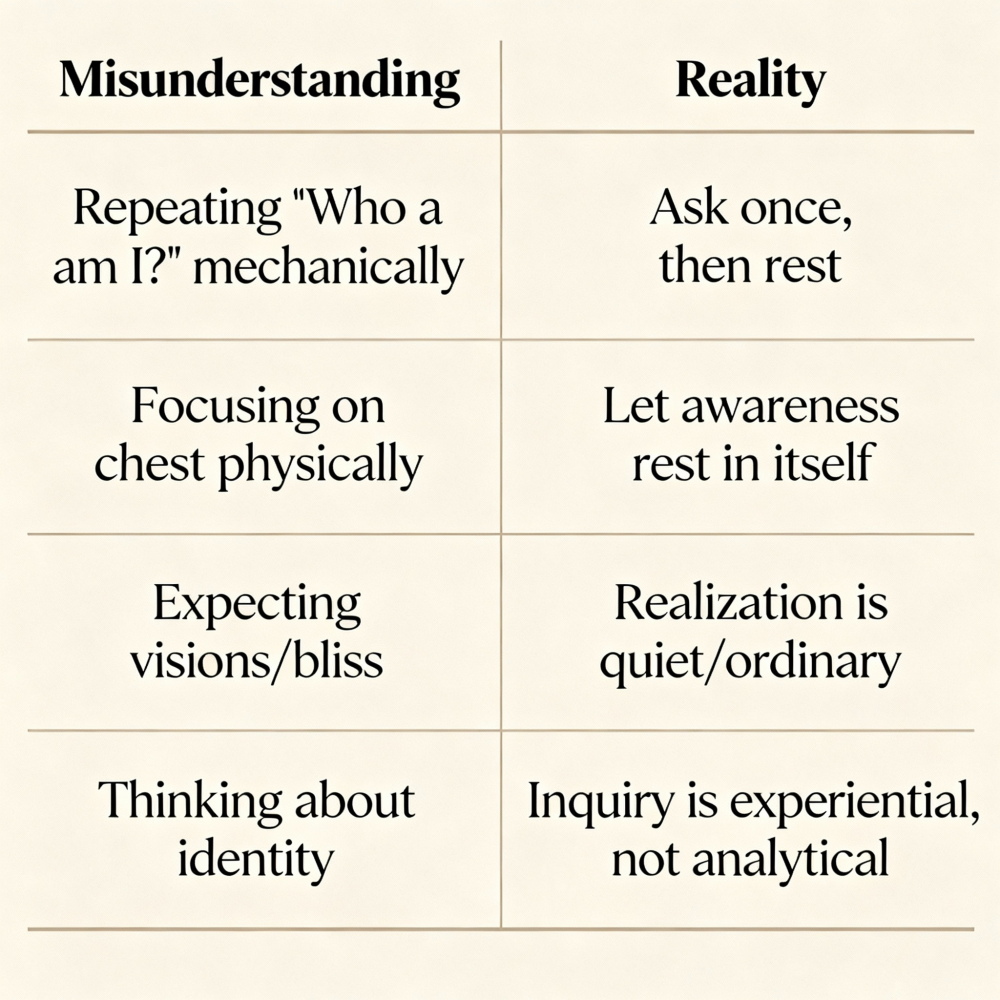
Once these misunderstandings are cleared, the real practice becomes remarkably simple.
How to Practice Ramana Maharshi’s Self-Inquiry
When I first tried self-inquiry, I got lost making the process much more complicated than it needed to be. I thought I had to sit for an hour in perfect silence with my spine straight and my mind completely empty. Over the years, though, guided by clear voices like Sadhu Om, I’ve settled into a simple rhythm that works for me and many others.
Here are the practical steps, broken into daily moments. And remember—Sadhu Om taught that “self-inquiry is the quiet abandonment of the mind.” It’s not something you accomplish through effort. It’s something you allow.
As Ramana said, “Effortless awareness is our real nature.” The practice is really about remembering what you already are, not becoming something new.
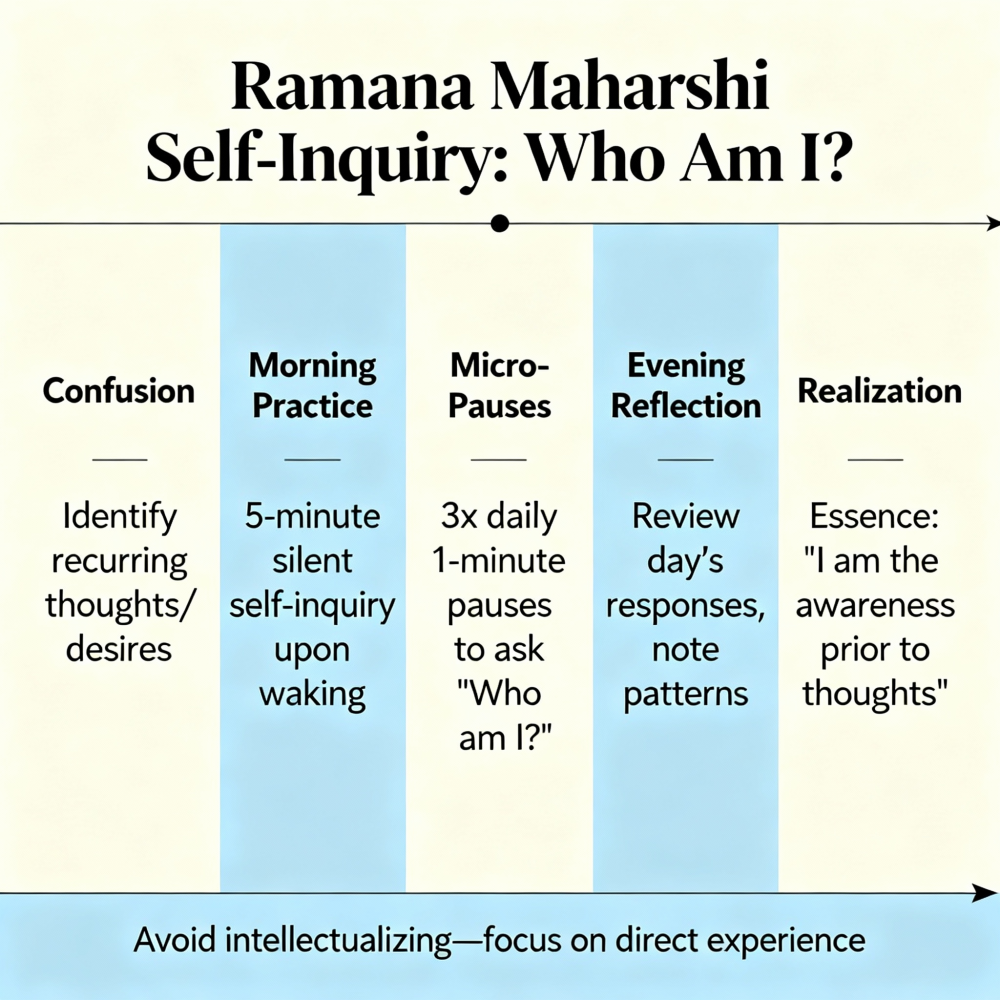
Morning Grounding
Sit quietly, either before breakfast or whenever you can carve out a few calm minutes. This is a good time because your mind is still relatively quiet, not yet pulled into the day’s demands.
Start by feeling the raw sense of “I exist.” Don’t try to describe it. Don’t label it. Just notice that you know “I am.” There’s a subtle warmth to it, an immediate presence that doesn’t need proof or thought.
When thoughts arise—and they will—try asking, “To whom do these thoughts come?” The honest answer is always, “To me.” When you sense this, drop the words. Become curious about the “me” to whom everything appears. Turn your attention back toward that feeling of being aware.
Sometimes you’ll feel a slight shift, like your attention settling back into itself. It’s hard to describe, but you’ll know it when it happens. There’s a spaciousness to it, a quiet that feels alive.
Micro-Pauses Through the Day
To be honest, I find these short breaks scattered throughout the day more helpful than a single, long meditation session. They keep you tethered to awareness without making it feel like a separate activity you only do at certain times.
When you notice your mind racing, or when you’re idle—like waiting for a webpage to load, standing in line at the store, or sitting at a red light—stop for ten seconds. Ask silently, “Who is aware right now?” or simply, “Who am I?”
There is always presence here. Always. So rest as that awareness for a breath or two before moving on. You’re not trying to achieve anything. You’re just checking in, remembering what’s always been here.
These small moments add up. They dissolve the sense of being separate from life, of needing to get somewhere. Each return softens the grip of the “I-thought” a little more.
Evening Reflection
When the day is almost done, I like to sit or lie down quietly for a few minutes. The house is settling. The noise has died down. It’s a natural time to reflect.
I ask, “Who witnessed this entire day?” And then I look back. All the experiences—the highs and lows, the frustrations and small joys—were known by the same quiet awareness. That awareness didn’t change. It didn’t get tired or overwhelmed. It just was.
Rest in that recognition for as long as you feel comfortable. Let the day dissolve into the stillness that held it all.
You don’t have to quiet the mind during this time. Truthfully, the mind quiets itself when you rest as the one who observes. It’s like clouds dispersing when you stop grabbing at them.
The Silent Shortcut
Sometimes self-inquiry can start to feel like effort. Like another thing on your to-do list. A chore. When that happens, I give myself permission to simply drop all questions and just feel, “I am.”
No technique. No process. Just a simple rest in being.
Often, just being still and noticing that I am here is enough to reconnect me to my natural awareness. It’s the most direct route home. Sadhu Om called this “self-abidance” (atma-nishtha)—just resting as what you are, without leaning forward into thought.
This is the heart of the practice. Everything else is scaffolding.
The Spirit of the Practice
For me, self-inquiry works best when I approach it gently. Many people push hard, thinking longer is better or that more effort means more progress. But in my experience, shorter returns to pure being—multiple times a day—work far better than long, strained sessions where you’re wrestling with your mind.
Self-inquiry isn’t something the mind accomplishes. It’s closer to gently letting go and falling back into your natural sense of existing, like leaning back into a chair you didn’t realize was there.
And here’s something important: you don’t need to wait for the perfect conditions. You don’t need silence or solitude or a special cushion. You can practice in traffic. At your desk. While washing dishes. Anytime you remember, you can ask, “Who is aware?” and return.
What Happens as Practice Deepens
The first thing I noticed as I continued with self-inquiry was my sense of “I” beginning to soften. Instead of feeling like a tight knot in my chest, a tense center that everything revolved around, my awareness started to feel more open. More undisturbed by what moved through it.
Over time, effort dropped away. I stopped feeling like I was “doing” self-inquiry and it became a quiet, natural presence underneath all activity. Like a hum you suddenly notice has been there all along.
As this deepens—and it does deepen, slowly and unevenly—the need to keep asking questions fades. The old seeking energy, always wanting answers, feelings, visions, or confirmation, starts to dissolve. What’s left is simple presence. Thoughts and worries still appear, but they seem less sticky. They pass through like weather, and you begin to realize you’re more like the sky than the clouds.
The “I” feeling, which once seemed so solid and central, starts to merge with a wider sense of awareness. This is what Ramana called the Heart. In these moments, there is no more searching. No more trying to get somewhere. What’s left is just clear, quiet being.
The Middle Ground: When Practice Feels Flat
There’s a stage that can happen in the middle of this deepening that throws people off. Everything starts to feel strangely flat. Not peaceful exactly, but neutral. No highs, no lows. The things that used to excite you don’t quite land the same way. The things that used to upset you feel distant.
The ego calls this emptiness. It wonders if something’s wrong, if you’ve lost your spark or your passion for life. But what’s really happening is that the mind is adjusting to peace. It’s so used to drama, to the constant ups and downs, that when stability appears it reads it as dullness.
This neutrality isn’t the end of the journey. It’s actually the ground clearing. The ego is losing its grip, and before joy and clarity fully settle in, there’s this in-between space. If you’re in it right now, trust it. Don’t try to stir up excitement or stimulation to escape the flatness. Let yourself be with the quiet. Real peace often feels ordinary, almost boring, until you see that it’s the most valuable thing there is.
Over time, what felt flat becomes spacious. What felt empty becomes full. You realize the peace was there all along—you were just waiting for it to feel like something else.
Subtle Changes in Daily Life
The changes from deepening inquiry often show up subtly, in ways you might not immediately connect to the practice. You might find a new calmness in stressful situations. A situation that once felt overwhelming, a difficult conversation, a deadline, an unexpected problem, now passes through you with more ease. Your center of gravity has shifted into something deeper, steadier.
Relationships can sometimes feel more open. Your reactions become softer. You still feel emotions, but there’s a gap now between the feeling and your identification with it. Anger arises, and instead of being consumed by it, there’s a quiet space that watches it appear and fade.
You begin to realize that the stories in your head, the endless narration about who you are and what’s happening and what it all means, don’t completely define reality. They’re just more content. More weather passing through.
And truthfully, this brings a kind of relief. A subtle lightness. You’re still you, still living your life, but there’s less weight to it all.
The Disappearance of the Seeker
Eventually, if you stay with this practice long enough, something shifts completely. The one who’s been searching starts to fade. You realize that the “you” who wanted to find enlightenment, who was doing all this inquiry, was just another appearance in awareness.
At first, self-inquiry feels like something you do. Later, it becomes who you are. Or more accurately, what you’ve always been.
This isn’t a permanent high or a state of constant bliss. It’s more like a baseline shift. A quiet recognition that runs underneath everything else. You’re no longer waiting for life to deliver something. You’re just here, present, seeing clearly.
The Real Meaning of the Heart
Ramana and his close students used the word “Heart” a lot, so it’s easy to get confused about what it really means. Over time, I’ve found that looking at how his closest disciples understood it helps clarify things. As Ramana said, “The Heart is the seat of pure consciousness.”
Muruganar’s Understanding
Muruganar was one of Ramana’s most devoted students and a Tamil poet who spent decades at his side. He described the Heart as pure consciousness itself, calling it the “I-I”—awareness shining in itself, aware of its own being without needing an object.
It’s the sense of being aware without any mental labels or identity attached. Not “I am this” or “I am that,” but just “I am,” without the addition. Pure existence-consciousness.
Sadhu Om’s Teaching
Sadhu Om, who studied with both Ramana and Muruganar, taught that if you feel a sensation in your chest during practice, it’s okay. Allow it. But understand that it’s only a passing phase. The real Heart is awareness itself, not a physical object or point in space.
He emphasized that you shouldn’t get stuck trying to locate the Heart somewhere. The practice is about turning attention back to its source, and if a chest sensation helps you do that initially, fine. But eventually, you have to go beyond even that.
Michael James’s Clarity
Michael James, a Western student of Sadhu Om, writes that the Heart shouldn’t be treated as a location at all, but as the inward-pointing center of experience. It’s the core of awareness that does not move, does not change, and is not found in space or time.
He explains it like this: everything you experience, every thought, sensation, perception, appears to a center point that is “you.” The Heart is that center, but it’s not a physical center. It’s the center of subjectivity itself. The place where you most intimately are.
Bringing It Together
When Ramana, Muruganar, Sadhu Om, and Michael James use the word “Heart,” they’re all pointing to the same silent awareness that gives rise to the “I.” It’s not a chakra, not a mystical organ, but the open field in which all experience appears.
In my own practice, the best approach has been to “hold on to ‘I am'” quietly, just as Ramana advised. If even that sense fades, if the “I am” becomes so subtle it nearly disappears, I just rest as open awareness itself.
The essence is not to get caught up in chasing experiences, locations, or special states. It’s to stay with the present sense of being. That’s the Heart. That’s home.
Ramana once said, “The Heart is not inside the body; the body is inside the Heart.” At first, that sounds backwards. But as you practice, you start to feel what he meant. Awareness doesn’t live somewhere in your chest. Your chest, your whole body, the whole world, appears in awareness.
Bringing Self-Inquiry Into Daily Life
The reason self-inquiry works for so many people, including me, is that it isn’t something special you only do on a meditation cushion. The practice fits smoothly into regular life. In fact, that’s where it really comes alive.
Whenever you remember—and at first, you’ll forget often, which is completely normal—pause and check: “Who is having this experience right now?” That gentle check-in can happen anywhere. At your desk while your computer’s loading. In the shower as water runs over your shoulders. While talking to someone who’s frustrating you. Even mid-scroll through social media.
Presence and Self-Inquiry
There’s a strong link between Ramana’s self-inquiry and what Eckhart Tolle calls “presence.” Both practices help you notice awareness itself, what’s here before thoughts, emotions, or stories take over. If you’ve struggled with mind-based meditation or feel stuck trying to watch your breath, this approach might feel much simpler and more accessible.
You’re not trying to achieve a particular state. You’re just noticing what’s already awake and aware. That simple noticing shifts everything.
Self-Inquiry in Action
Let’s say you’re in the middle of a stressful day. Something goes wrong. Your heart rate picks up. Frustration floods in. In the past, you’d just ride that wave, maybe snapping at someone or stewing in it for hours.
But now, you pause for a second. “Who is frustrated?” you ask silently. And in that instant, there’s a gap. The frustration is still there, but you’re not completely lost in it. You’re the space in which the frustration appears. That changes the whole dynamic.
Or maybe you’re at your computer, staring at an overwhelming inbox, feeling that familiar tightness in your chest. You could spiral into stress. Or you could ask, “Who feels overwhelmed?” Just that simple question creates breathing room. You’re still going to answer the emails, but there’s less drama around it.
Or you’re with your kids and one of them is having a meltdown. The noise, the crying, the chaos—it all feels like too much. Before reacting, you pause. “Who is irritated by this?” In that pause, you find a little space. A little softness. You’re still going to handle the situation, but you handle it from a calmer place.
The practice isn’t about transcending life or rising above emotions. It’s about meeting everything from a place of awareness instead of pure reaction.
When Inquiry Becomes Life
As inquiry matures, it stops being a practice you remember to do. It becomes the background of your life. You’re not constantly asking “Who am I?” anymore. You’re just being. Living and practice merge into the same thing.
That’s what ends the constant searching for something “more.” You realize you’re already home. You always were.
The Self, as Ramana taught, “is ever-present. What changes cannot be the Self.” This recognition doesn’t come from thinking about it. It comes from the simple, repeated gesture of turning attention back to what’s aware.
Recommended Reading
If you want to go deeper into Ramana’s teachings, here are the books I return to again and again. They’re not academic texts. They’re living guidance from people who walked this path themselves.
Who Am I? by Ramana Maharshi
This is Ramana’s foundational text, a short set of questions and answers that captures the essence of self-inquiry. It’s brief—you can read it in twenty minutes—but it contains everything you need. I keep coming back to it because there’s always something new to see in its simplicity.
The Path of Sri Ramana by Sadhu Om
Sadhu Om was Ramana’s disciple and spent years sitting with him. This book explains self-inquiry with relatable examples and practical tips. It’s probably the clearest commentary on the practice I’ve found. If you only read one book after Ramana’s own words, make it this one.
Be As You Are by David Godman
David Godman collected and organized Ramana’s teachings from various sources and presented them in an accessible format. This book answers common beginner questions and covers all aspects of Ramana’s teaching clearly. It’s less poetic than some texts, but that directness is helpful when you’re trying to understand what to actually do.
Talks with Sri Ramana Maharshi
This is a record of actual conversations between Ramana and visitors. Reading these dialogues gives you a sense of how Ramana responded to people’s questions in the moment. It’s not always linear, but that’s part of its value. You see how the teaching adapts to each person’s understanding.
And if you want a simple daily structure to work with, feel free to download the free Daily Self-Inquiry Routine PDF here. It’s just a handy checklist to remind you of the steps throughout the day.
Frequently Asked Questions
Over the years, I’ve heard the same questions come up again and again. Here’s what people usually ask me, along with what I’ve learned through practice:
Should I repeat “Who am I?” all day?
No. Self-inquiry is not about repetition. It’s about turning your attention toward awareness, toward the sense of “I” before the mind creates thoughts about it. Ask once, sincerely, and then feel for the answer beyond words.
What do I do if my mind keeps wandering?
Minds wander. That’s what they do. Mine still does. When you notice the wandering—and noticing is the key thing—simply ask, “To whom has this wandering occurred?” Use that moment as a doorway. Gently return attention to the sense of being aware. That’s the practice.
Is this the same as mindfulness or being present?
It’s similar, but self-inquiry specifically looks at the root sense of “I.” Mindfulness teaches you to watch experiences as they arise and pass. Inquiry goes a step further and asks, “Who is it that knows these experiences?” It’s a subtle but important difference.
How long should I practice each day?
Honestly, small, frequent check-ins work best. Even ten seconds at a time, several times a day, can bring real clarity and lessen the mind’s constant chatter. Don’t wait for a perfect hour-long window. Use the moments you have.
Should I focus on the heart area in my chest?
If awareness naturally feels centered there, allow it. But don’t force your attention onto a physical spot. The practice is about resting as awareness itself, not concentrating on a location. The chest sensation, if it comes, is just a signpost. It’s not the destination.
Conclusion

The most important lesson I’ve learned over years of practice is that self-inquiry really is simple, direct, and natural. It’s not reserved for monks or mystics. It’s not something you need to earn through decades of meditation. It’s available right now, in this moment, because awareness is always here.
The next time you catch yourself lost in thought, spinning in worry or lost in planning or replaying some conversation for the tenth time, pause. Quietly ask, “To whom does this come?” Notice the quiet sense of presence that’s always here, beneath the noise. Rest as the aware space behind every experience.
That’s it. That’s the whole practice.
Over time, this simple gesture deepens into something you can’t quite put into words. It becomes a way of living. A way of being that feels effortless and obvious, like finally remembering something you’d forgotten but never really lost.
The Heart—that source of pure awareness—was never far away. You just had to stop looking for it long enough to realize you were already there.
The Self does not need to be found—only remembered.
Related Posts and Videos:
Presence vs. Mindfulness: What’s the Real Difference?
How to Stop Overthinking: The Power of Now in Action
Why Asking ‘Who am I?’ Doesn’t Work, and What To Do Instead

Chris is the voice behind Daily Self Wisdom—a site dedicated to practical spirituality and inner clarity. Drawing from teachings like Eckhart Tolle, Ramana Maharshi, and timeless mindfulness traditions, he shares tools to help others live more consciously, one moment at a time.Learn more about Chris →
Thank you for such a detailed write up. Very simple and clear. Is there anywhere to reach you personally to clarify few doubts in the practice?
Thank you so much for your kind words. I’m really glad the article was helpful. At the moment I’m not offering personal one-to-one guidance, but you’re very welcome to share your questions here in the comments. I’ll do my best to reply when I can, and it may also be useful for other readers with similar doubts (and they might add their own insights too).