You sit down, maybe cross-legged or just on the couch, close your eyes, and begin. You ask, “Who am I?” For a brief moment, the question lands somewhere real. Then, almost without noticing, something shifts. You’re no longer asking. You’re thinking about asking. You’re observing your state, narrating your stillness, wondering whether the inquiry is working. The question disappears and commentary takes its place. That subtle shift is the beginning of self-inquiry mental looping.
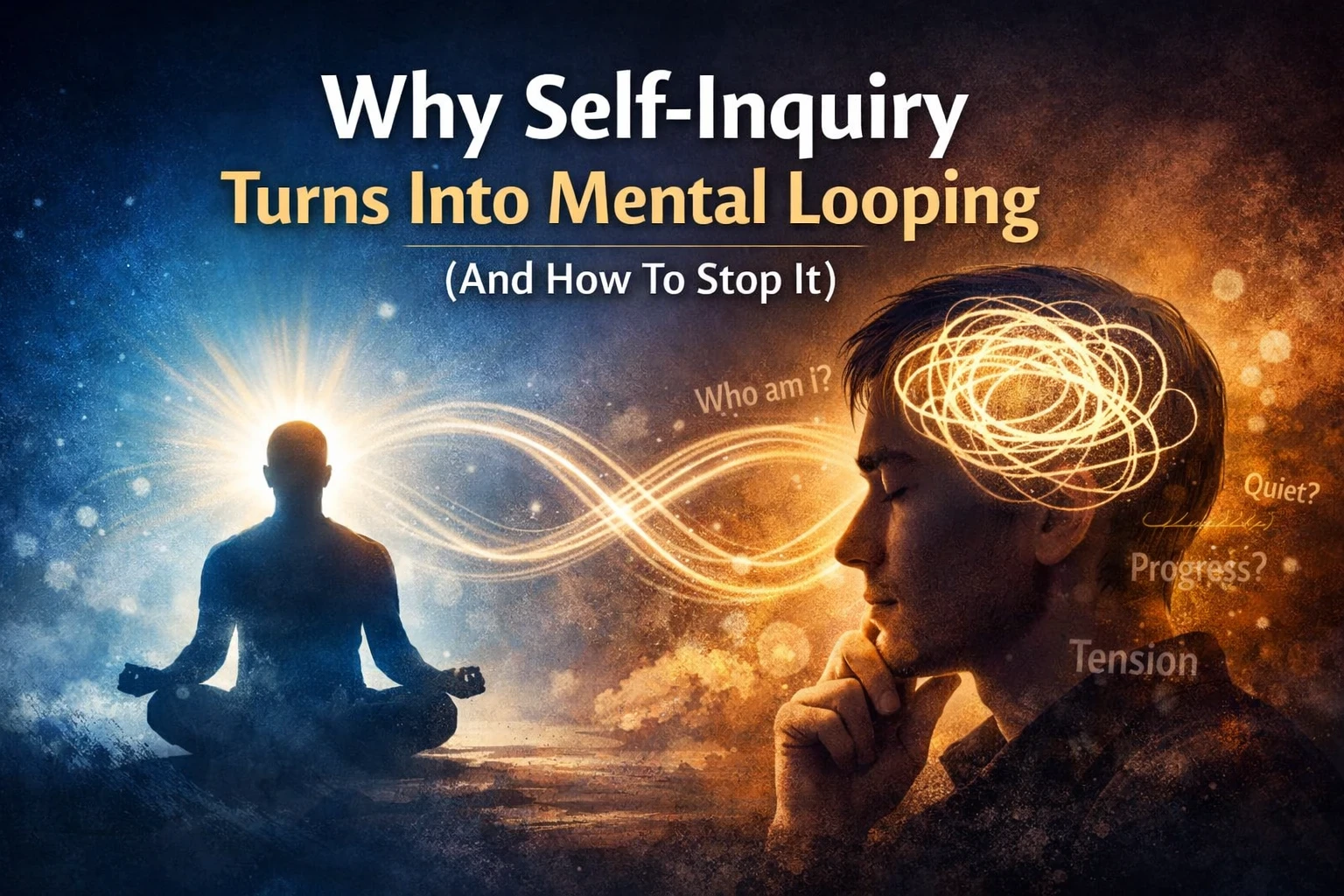
This isn’t a sign that you’re doing it wrong. But it is the central trap of Ramana Maharshi’s self-inquiry, and it’s far more deceptive than it seems. The mind doesn’t abandon the practice. It mimics it. And the imitation is convincing enough that many sincere practitioners spend months, sometimes years, lost in a loop they can’t see clearly.
Getting honest about the difference between real attention and refined thinking is one of the most clarifying things you can do for your practice. Not because it’s complicated, but because the two feel so similar from the inside.
Here’s a video that gets into this exact trap. I recommend watching it after you’ve read through the main ideas below.
What Self-Inquiry Mental Looping Actually Looks Like
Self-inquiry mental looping doesn’t show up as loud, scattered thinking. That would be easier to catch. It shows up as something quieter, more internal, and strangely purposeful.
It might look like mentally repeating “Who am I?” until it becomes automatic, more like a mantra than a real question. Or analyzing the quality of your awareness from one moment to the next: “Am I resting as the self right now?” “Where is my attention?” Or tracking and narrating inner states as they change: “Now there’s some quiet. Now tension. Now a kind of spaciousness.” Or checking in with yourself mid-session, wondering whether you’re closer to something than you were a few minutes ago.
There’s also a subtler version. A quiet inner voice that grades each moment, applauds stillness as progress, or flags distraction as failure. This voice doesn’t feel like distraction. It feels like discernment. That’s precisely the problem.
This kind of thinking feels refined because it is refined. It’s not noisy or chaotic. It’s focused, sincere, and spiritually themed. For intelligent practitioners especially, this is where self-inquiry mental looping tends to settle in. The mind finds a register that feels like depth, and it stays there. The core activity, however, hasn’t changed at all. It’s still thinking. Just thinking about awareness rather than thinking about something else.
Why Thinking Cannot Observe the Thinker
The mind has a convincing trick: it creates the impression that it can turn around and spot the one doing the thinking. Thought can analyze past thoughts. It can comment on present sensations. It can construct a detailed inner report of what your experience is like right now. But it cannot locate the actual subject behind those experiences. Every time thought turns inward to “find” the observer, what appears is more thought. More concepts, more impressions, more mental objects.
This matters because many people approach self-inquiry as if the “I” is something they’ll eventually think their way to. They imagine that with enough focused introspection, the observer will come into view. But the assumed “thinker” is itself just another object in awareness, a familiar sensation, a mental image, a felt sense of a separate self. It has no more access to the real subject than a word on a page has to the person reading it.
Here’s a way to feel this directly. When you try to look at your own awareness through thought, notice what actually happens. There’s a kind of internal reaching. Something grasps or tilts toward itself. And then? More thoughts about awareness. More words. Maybe a brief sense of something quiet underneath it all, but then the narration picks back up, describing that quiet.
That reaching is the loop. The moment attention stops trying to observe itself through the mind’s lens, something else is already here.
If you find yourself able to describe your current awareness in words, the description is the sign that you’ve moved from attention to cognition. You’re no longer pointing at the “I.” You’re reporting on the experience of looking.
Why Mental Looping Feels Productive
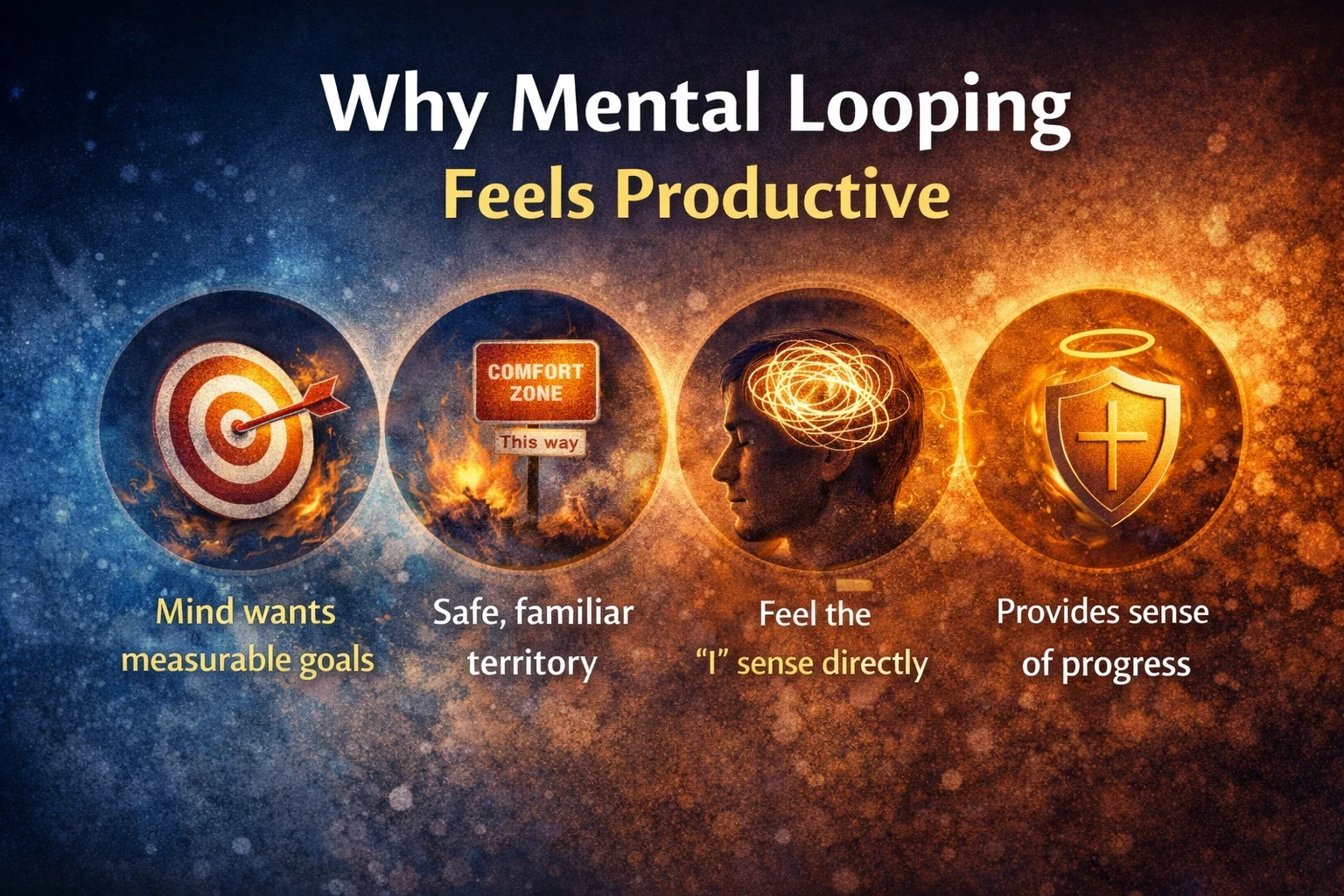
Mental looping doesn’t feel like a mistake. That’s what makes it so persistent. There are real psychological reasons this pattern settles in and stays.
The mind is oriented toward goals, movement, and evidence. Self-inquiry offers almost none of that. There’s no visible landmark, no measurable result, no clear sense that this session accomplished more than the last one. That open-endedness is uncomfortable, and the mind will move quickly to fill it with something that feels like progress.
Looping fills that gap. Tracking your inner states, analyzing your quality of presence, narrating subtle shifts in perception: all of this generates a sense of activity. The ego reads activity as movement, and movement as progress. It doesn’t matter that none of it is leading anywhere. The feeling of doing something is enough to keep it going.
There’s also a comfort dynamic at work. Mental activity, even spiritually flavored mental activity, is familiar territory. The thinking mind knows how to think. What it doesn’t know how to do is rest without narrating. When the inquiry opens into genuine silence, that silence can feel like absence. Like nothing is happening, which to the goal-oriented mind means nothing is working. The loop restarts not out of failure but out of a deeply habitual discomfort with bare, uncommented presence.
Rumination and pure awareness become distinct at exactly this point. Rumination thinks in circles, even when the subject is your own inner life or spiritual development. Awareness doesn’t narrate itself. It doesn’t check in. It doesn’t need to report on its own quality. It simply notices, without turning that noticing into content. If you’re unsure where your practice falls on this spectrum, the distinction between self-inquiry, presence, and mindfulness can help clarify where genuine attention ends and mental commentary begins.
The Critical Distinction Ramana Pointed To
Ramana Maharshi was precise about this. Self-inquiry is a practice of attention, not cognition. The question “Who am I?” is not a riddle to be solved by thinking harder or looking more carefully at the contents of the mind. It’s a pointer. Its entire function is to redirect attention from objects toward the subject. Once it does that, the question has done its job.
The actual movement of self-inquiry is simple, almost uncomfortably so.
A thought appears, or a sensation, or a distraction. You notice it. You ask: “To whom has this appeared?” The answer comes naturally: “To me.” And then, instead of following that “me” into analysis or story, you let attention rest in that direct, simple sense of being here. Not thinking about it. Not describing it. Just being present as it.
That’s it. There’s no step after that. The “I” sense doesn’t need to be examined, understood, or confirmed. The practice is resting there, without commentary, and returning whenever the commentary resumes.
This is where the real shift happens for most practitioners. The question isn’t a tool to use repeatedly. It’s a direction. When attention is already pointed at the right place, repeating the question adds nothing. And yet the mind, uncomfortable with that simplicity, will often keep the question running just to have something to do.
How to Tell When You’re Caught in Mental Looping
The most reliable test is also the simplest: if you can put your current inner experience into words, you’re thinking. Not meditating, not inquiring, thinking. The moment internal commentary becomes possible, attention has already shifted from the subject to the objects.
This doesn’t mean something has gone wrong. Mental looping can only continue while there’s a “me” doing the monitoring. The moment you clearly see the loop for what it is, that seeing is already outside the loop. You don’t have to force your way out. Recognition itself is the interruption.
What catches people is the gap between seeing the pattern in theory and catching it in real time. The commentary is convincing because it mirrors the language of inquiry. “Am I resting as awareness?” sounds like a self-inquiry question. In practice, it’s the mind checking its own progress. The question has an object: your current state. Real self-inquiry has no object to analyze. Attention points toward the one asking, not the condition of the asking.
How to Stop Self-Inquiry Mental Looping
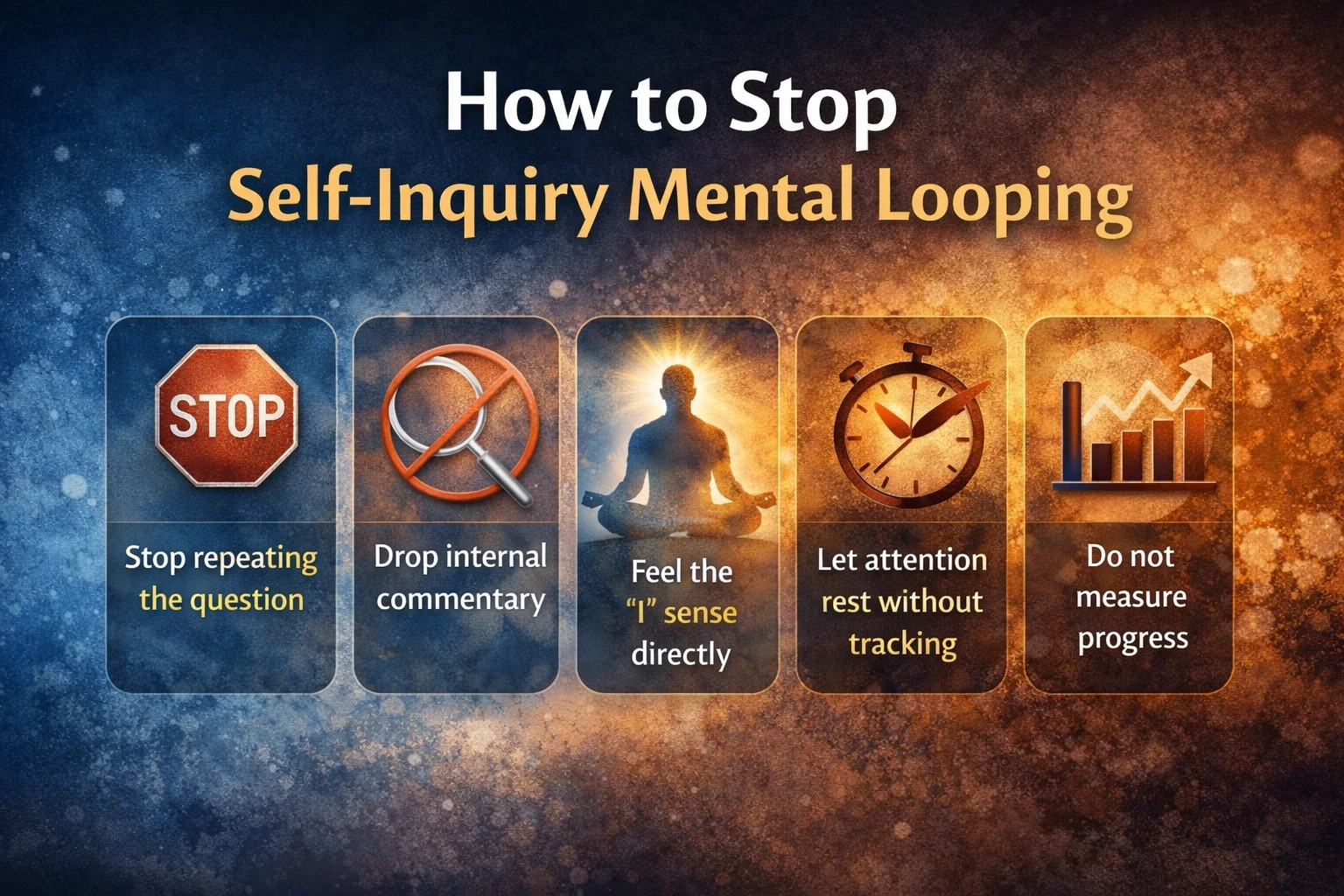
When you catch the loop, the response isn’t to fix it or analyze why it happened. The response is to stop adding to it.
Let the question drop if it’s become mechanical. If “Who am I?” is running on autopilot, repeating without actually redirecting attention, pause it. Let the silence be there without immediately filling it again.
Drop the internal commentary entirely. Don’t explain your state to yourself. Don’t grade the session. Don’t narrate the shift back to presence. All of that is more looping, just with a different subject. The mind will often announce “okay, now I’m really present,” which is its way of staying involved. Notice that too.
With the inner commentary quiet, feel for the raw “I” sense. Not the thought of “I.” The immediate, pre-verbal sense of being here. It doesn’t feel like anything in particular. It’s not dramatic. It’s the simple familiarity of being aware, before any description of that awareness is added.
Rest there without measuring the duration or quality. If the loop returns, no frustration is needed. Just recognize it and let attention ease back. The return is the practice. Over time, the gap between looping and noticing grows shorter, and returning becomes less effortful.
Self-Inquiry Is Radically Simple
The deepest difficulty of self-inquiry is its simplicity. There is nothing to accumulate, no inner state to develop, no refined understanding to reach. Thought would like to participate, to help, to make itself useful. But the practice doesn’t need thought. It only needs attention.
The less the mind “understands” what’s happening during genuine inquiry, the closer you tend to be to what Ramana was pointing at. Understanding is another object. The subject cannot understand itself because it isn’t an object.
Mental looping stops the moment commentary stops. Not gradually, not with practice, right then. The loop requires a narrator. When narration pauses, the loop has nowhere to go. What remains isn’t emptiness. It’s the simple awareness that was always present behind the commentary, waiting for nothing because it was never absent.
Patience and lightness help. Some sessions will be filled with looping from start to finish. That’s fine. Catching the loop once, clearly, can be more valuable than long stretches of silence you’re unsure about. Over time, direct awareness becomes more familiar than thought, and the pull toward mental commentary naturally weakens.
Frequently Asked Questions
Is self-inquiry supposed to feel empty?
At first, yes, it can feel that way. That sense of emptiness is mostly the absence of familiar commentary. With time, what felt like an empty gap begins to feel more like a quiet, stable presence. The emptiness was never really empty. It was just unfamiliar.
Is repeating “Who am I?” wrong?
No. The repetition becomes a problem when it turns mechanical, more like chanting than questioning. If it’s genuinely redirecting attention toward the “I” sense, it’s doing its job. If it starts to feel automatic, pause it. Let attention rest without the support of the question.
How is rumination different from inquiry?
Rumination is thinking in circles about your inner state, your progress, or your experience of the practice. Inquiry is resting as the awareness that watches all of that without joining the commentary. The difference isn’t subtle once you feel it clearly, but it often looks identical from the outside.
Why does looping feel spiritual?
Because the content is spiritual. The mind packages its activity in the language of awareness, presence, and self-inquiry. That framing makes the thinking feel legitimate, even insightful. But spiritual content doesn’t change the fact that it’s still content. Thinking about awareness is not the same as being aware.
Can beginners avoid this mistake?
Mostly not, and that’s fine. Mental looping is extremely common across all levels of practice. The key isn’t to prevent it but to recognize it when it happens, and to return without drama. That recognition and return is itself the practice deepening. For a closer look at why this pattern is so persistent and what else can derail the practice, see why self-inquiry fails.
Wrapping Up
Self-inquiry mental looping isn’t something to eliminate permanently. It’s something to recognize. Each time you see it clearly and stop feeding it, attention stands on its own again. That simplicity is the practice.
If you want to understand self-inquiry exactly as Ramana Maharshi taught it, without commentary or reinterpretation, Be As You Are remains one of the clearest sources available. It presents his teachings directly, including detailed explanations of the “Who am I?” method and the subtle mistakes that derail it.

Chris is the voice behind Daily Self Wisdom—a site dedicated to practical spirituality and inner clarity. Drawing from teachings like Eckhart Tolle, Ramana Maharshi, and timeless mindfulness traditions, he shares tools to help others live more consciously, one moment at a time.Learn more about Chris →
Leave a Reply