If you’ve ever felt overwhelmed by your thoughts or trapped by your mind’s constant chatter, you’re absolutely not alone. A lot of us believe that we are what we think and feel, which can make daily ups and downs feel a lot heavier than they need to be.
The Bhagavad Gita offers a really different way of seeing all this, with the powerful lesson that you are not the mind. This teaching, often called the “you are not the mind Bhagavad Gita lesson,” appears at a crucial moment in the text. This isn’t about ignoring thoughts or pretending emotions don’t exist.
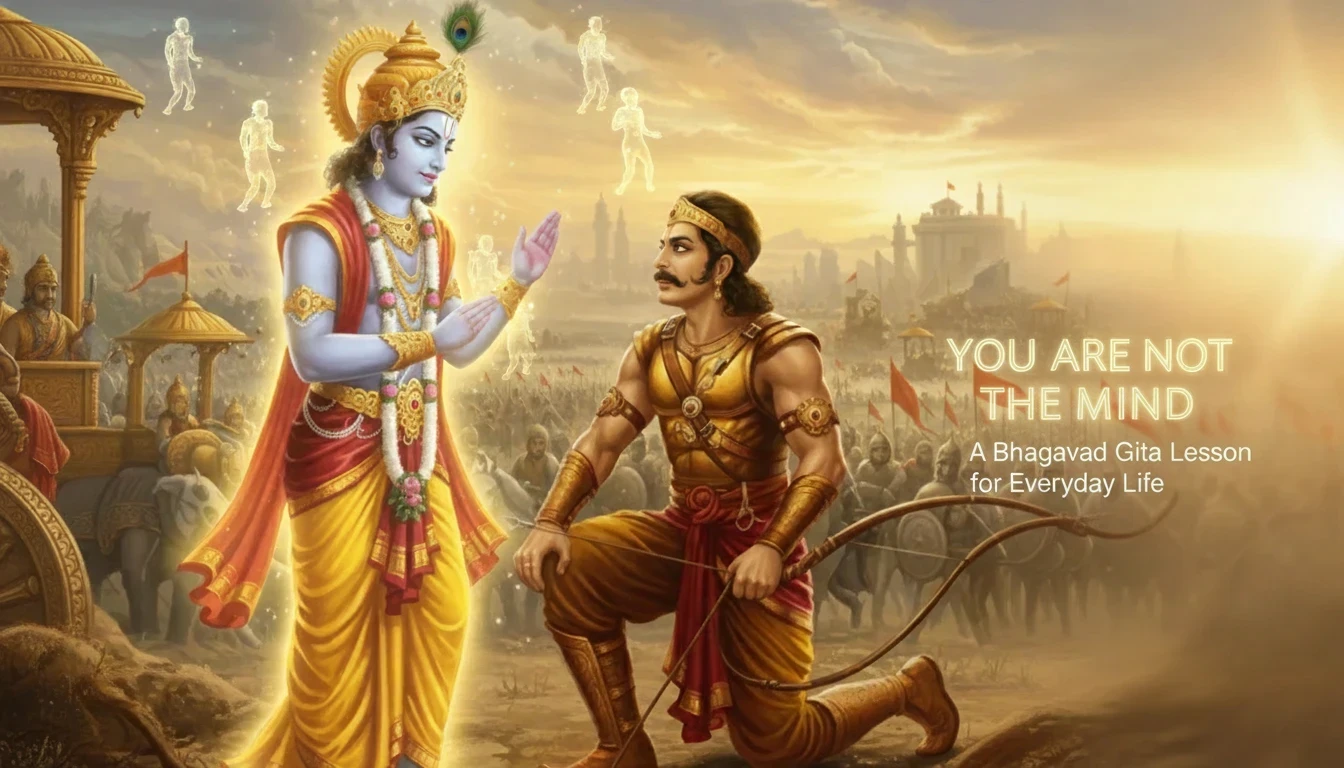
Instead, it’s about realizing that awareness sits a bit apart from the mind, and that realization opens up a whole new way to live. This is the second lesson in my ongoing Bhagavad Gita series. If you missed the first one, I covered You Are Not the Body, which ties directly into what you’ll read here.
What the Bhagavad Gita Means by You Are Not the Mind
To understand this teaching fully, we need to step into the scene where it first appears. The Bhagavad Gita opens on a battlefield, with the warrior Arjuna standing in his chariot between two massive armies. His charioteer is Krishna, who is actually a divine teacher in human form.
As Arjuna looks out at the soldiers on both sides, many of whom are his own relatives, teachers, and friends, he becomes completely overwhelmed. His mind floods with doubt, fear, grief, and confusion. He drops his bow, his body trembles, and he tells Krishna he cannot fight.
This moment is crucial because Arjuna’s crisis isn’t really about war. It’s about what happens when the mind takes over completely. His thoughts spiral into worst-case scenarios. His emotions paralyze him. He can no longer see clearly or act decisively. Sound familiar? Most of us have had moments like this, maybe not on a battlefield, but in situations where our minds simply would not stop talking, judging, and catastrophizing.
Krishna’s response to Arjuna forms the heart of the Gita’s teaching. He doesn’t just give tactical advice about the battle. Instead, he begins by addressing the root of Arjuna’s suffering: his identification with the mind and its endless fluctuations.
Krishna teaches Arjuna that his true Self, called the Atman, is not the body, not the emotions, and not the thoughts racing through his head. The Atman is pure awareness, the unchanging witness behind all mental activity.
The Gita has something pretty eye-opening to say about the mind. It calls the mind a tool, more like a computer running in the background, not who you actually are. The real you, the part that stays steady through all the ups and downs, is the witness or the observer. Krishna uses the Sanskrit word sakshi to describe this witnessing consciousness. For me, that’s a really down to earth description of something that can otherwise sound abstract.
Krishna acknowledges how difficult the mind can be to work with. In Chapter 6, Arjuna actually pushes back and says the mind seems impossible to control:
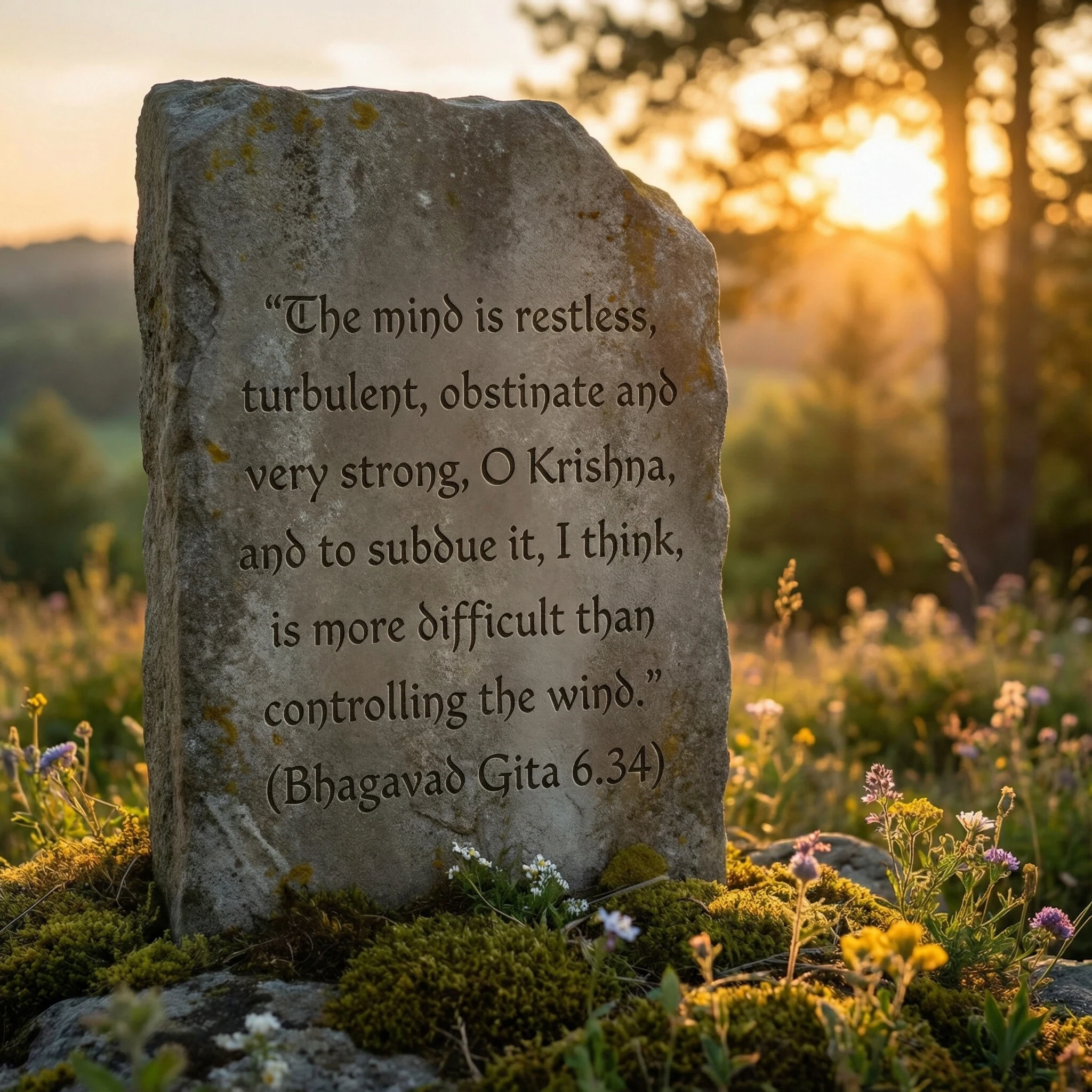
“The mind is restless, turbulent, obstinate and very strong, O Krishna, and to subdue it, I think, is more difficult than controlling the wind.” (Bhagavad Gita 6.34)
Krishna doesn’t dismiss this concern. He agrees that the mind is indeed restless and hard to master. But he also offers hope:
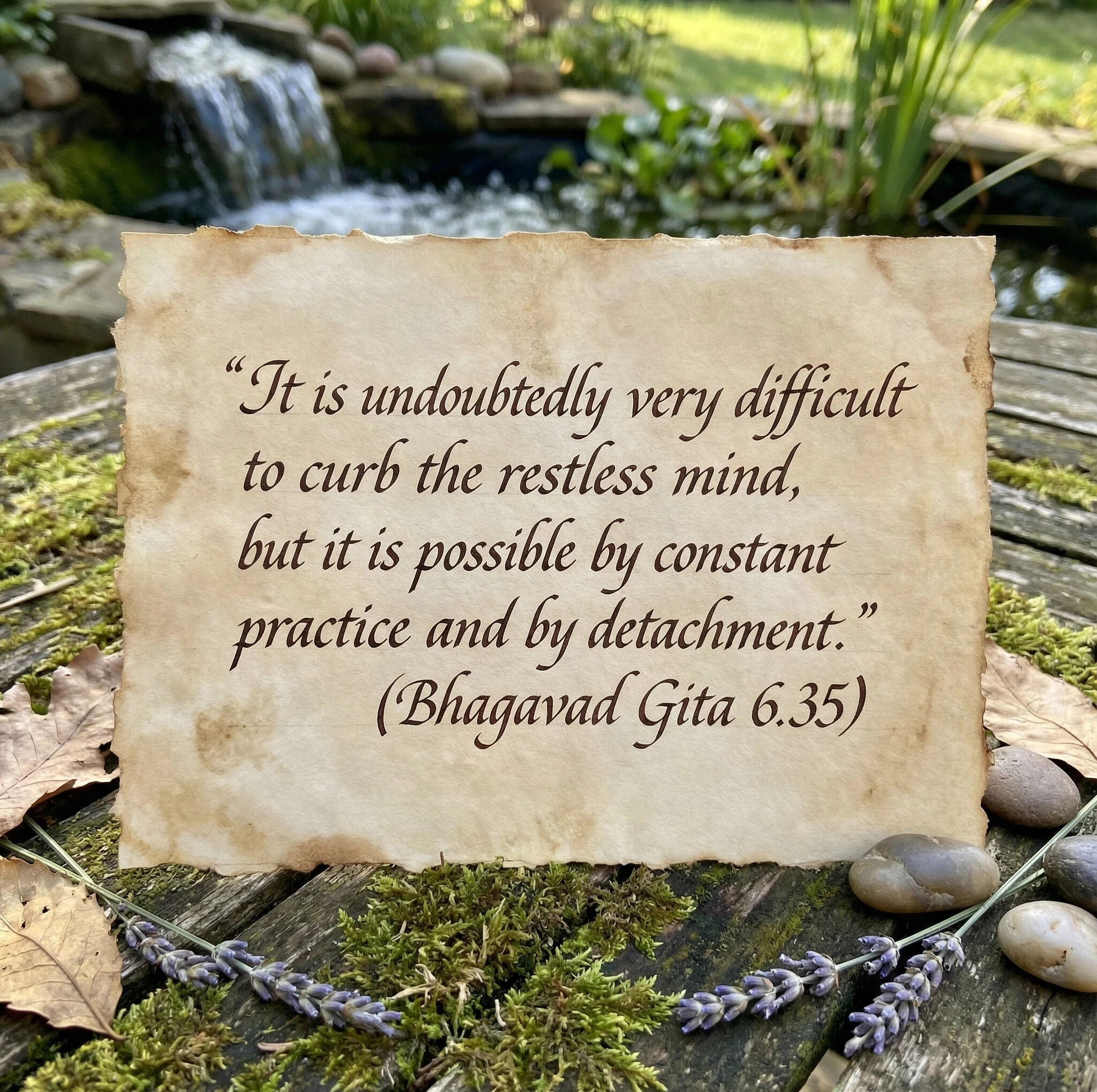
“It is undoubtedly very difficult to curb the restless mind, but it is possible by constant practice and by detachment.” (Bhagavad Gita 6.35)
This exchange is incredibly reassuring. Even thousands of years ago, people struggled with the same mental overwhelm we face today. The Gita doesn’t pretend that quieting the mind is easy. It simply points to a path forward through steady practice and a shift in how we relate to our thoughts.
Thoughts, feelings, and impulses show up inside your mind, but they aren’t your core self. If you can watch a thought come and go, there has to be something else, call it awareness, consciousness, the Atman, or whatever word fits, that’s doing the watching in the first place.
None of this is about rejecting the mind or fearing it. It just means seeing thoughts as passing events, a bit like clouds moving across the sky. Sometimes, the mind is helpful and creative. Other times it spins stories that make you anxious or upset. In both cases, you’re still the one watching from behind the scenes.
The Real Problem: The Mind Never Stops Talking
If you’ve ever gotten stuck in overthinking or held onto an emotional spiral for hours, you know how noisy the mind can get. Our minds jump between worries, plans, doubts, and daydreams with barely any pause.
For most people, this background noise becomes so steady, it feels normal. The real trouble isn’t that the mind talks, it’s that most of us strongly identify with everything it says.
Krishna addresses this directly in the Gita. He explains that the mind can function as either a powerful ally or a destructive enemy, depending on whether we master it or let it master us:
“For him who has conquered the mind, the mind is the best of friends; but for one who has failed to do so, his mind will remain the greatest enemy.” (Bhagavad Gita 6.6)

This verse really lands for me. The mind itself isn’t the problem. It’s our relationship to the mind that determines whether we experience peace or suffering. When we believe every thought, follow every impulse, and get swept away by every emotion, the mind becomes a tyrant. But when we learn to observe the mind from the position of the witness, it transforms into a useful instrument.
Whenever I catch myself lost in self-talk, like picturing the worst-case scenario or replaying awkward moments, it’s easy to forget there’s any gap between “me” and the stream of thoughts. That’s exactly what Krishna points to as a core human struggle. The confusion happens when the observer, the Atman or real Self, gets completely tangled with the mind’s storytelling. This mix-up creates stress, worry, and a feeling of being on a mental rollercoaster.
Arjuna’s situation on the battlefield perfectly mirrors this experience. His mind was telling him stories about the future, about guilt, about loss, about what everyone would think of him. Those stories felt so real and so urgent that he couldn’t move. Krishna’s teaching helped him step back from the mental drama and reconnect with the part of himself that remained untouched by all the chaos.
It can help to just watch this in daily life. Think about how one thought, say, “I’m not good enough,” can turn into a whole movie of imagined failures and regrets. The Gita’s teaching can be a real relief here. It reminds me that every story my mind cooks up is just that, a story, not the truth of who I am.
The Simple Awareness Test
So how can you tell you’re separate from your thoughts? Here’s a quick and practical test: close your eyes for a few moments and just wait. Notice when a thought appears. It could be anything, something about your day, a memory, maybe the words “this is weird.” The key thing is noticing that you are able to observe the thought itself.
If you can see a thought, that means you aren’t the thought. For example, right now as you read this, you might be thinking about whether this idea makes sense, or maybe wondering what you’ll eat later. In both cases, there’s a part of you watching those thoughts arrive and pass by.
This is exactly what the Gita means by the sakshi or witness. The witness doesn’t judge, react, or get involved. It simply sees. Krishna teaches Arjuna that this witnessing awareness is his true nature, the Atman, which remains constant and unchanging even as the mind swings wildly between states. The body changes, emotions come and go, thoughts rise and fall, but the awareness that perceives all of this remains steady.
Whenever I use this little test, it creates a bit of distance between me and whatever is flying through my mind. It doesn’t make thoughts stop, but it does make them feel a little less personal and overwhelming. That bit of space is super important. It’s like realizing you’re in the audience watching a movie, not actually stuck inside the film itself.
This simple shift in perspective, from being the thinker to being the witness of thinking, is really the essence of what Krishna teaches Arjuna. It’s not complicated philosophy. It’s a direct, experiential recognition that you can verify for yourself right now.
How to Apply This Teaching in Daily Life
All these ideas can sound pretty deep, but the point is real-life happiness and peace, not just philosophy. Krishna didn’t teach Arjuna so that Arjuna could sit around contemplating abstract concepts. He taught him so that Arjuna could act clearly and decisively, free from the grip of mental confusion. I’ve found a handful of steps that make it easier to bring this teaching from the Bhagavad Gita into my regular life. Try the following for yourself and see what changes:
Notice when a thought appears. Throughout your day, just watch out for moments when you realize a thought has popped up. It could be a worry, a plan, or just random mental chatter. This simple noticing is the beginning of discriminative awareness (viveka in Vedanta), the ability to see the difference between the Self and the not‑Self.
Label the thought gently. You might say in your head, “That’s a worry,” “That’s a memory,” or “That’s planning.” This simple label helps keep the thought from taking over. It reinforces the position of the witness.
Switch attention to breath or body. If you start getting lost in the thought, gently move your focus to your breathing, the feeling of your feet on the floor, or the sounds around you. Krishna often points to focused attention as a way to steady the restless mind.
Return to awareness without fighting thoughts. The idea isn’t to wrestle your brain into silence. Just keep coming back to simple noticing, awareness itself. Thoughts will come and go no matter what, and that’s totally fine.
This isn’t repression or avoiding thoughts. It’s about clarity, seeing what’s happening without drowning in it. I’ve found it creates a lot more calm and gives me the ability to choose which thoughts are worth my energy.
Sometimes, when a thought keeps returning, I’ll jot it down on paper instead of letting it swirl endlessly, just to get it out of my head and see it more clearly. That in itself can be freeing.
Over time, responding with awareness builds resilience to stress and helps keep you grounded even on tough days. If you stick with these steps, you may notice you become less reactive and more able to stay centered through challenges.
When I first started using this approach, it felt a little awkward, like I was watching someone else’s mind. But soon, I noticed a big drop in my stress levels. Instead of being trapped in thought-loops, I could spot them and gently pull my attention back.
This doesn’t erase all negative thinking, but it takes away a lot of its grip on my mood. The more I practiced, the more natural it felt, almost like learning a new language for my inner world.
Detachment Without Avoidance
People hear the word “detachment” and often think it means shutting down emotionally or becoming distant from life. That’s not what the Gita teaches. In fact, Krishna explicitly tells Arjuna to take action, to engage fully with his duty. The detachment Krishna recommends is internal, not external. It means staying connected to the witnessing awareness while still participating wholeheartedly in life.
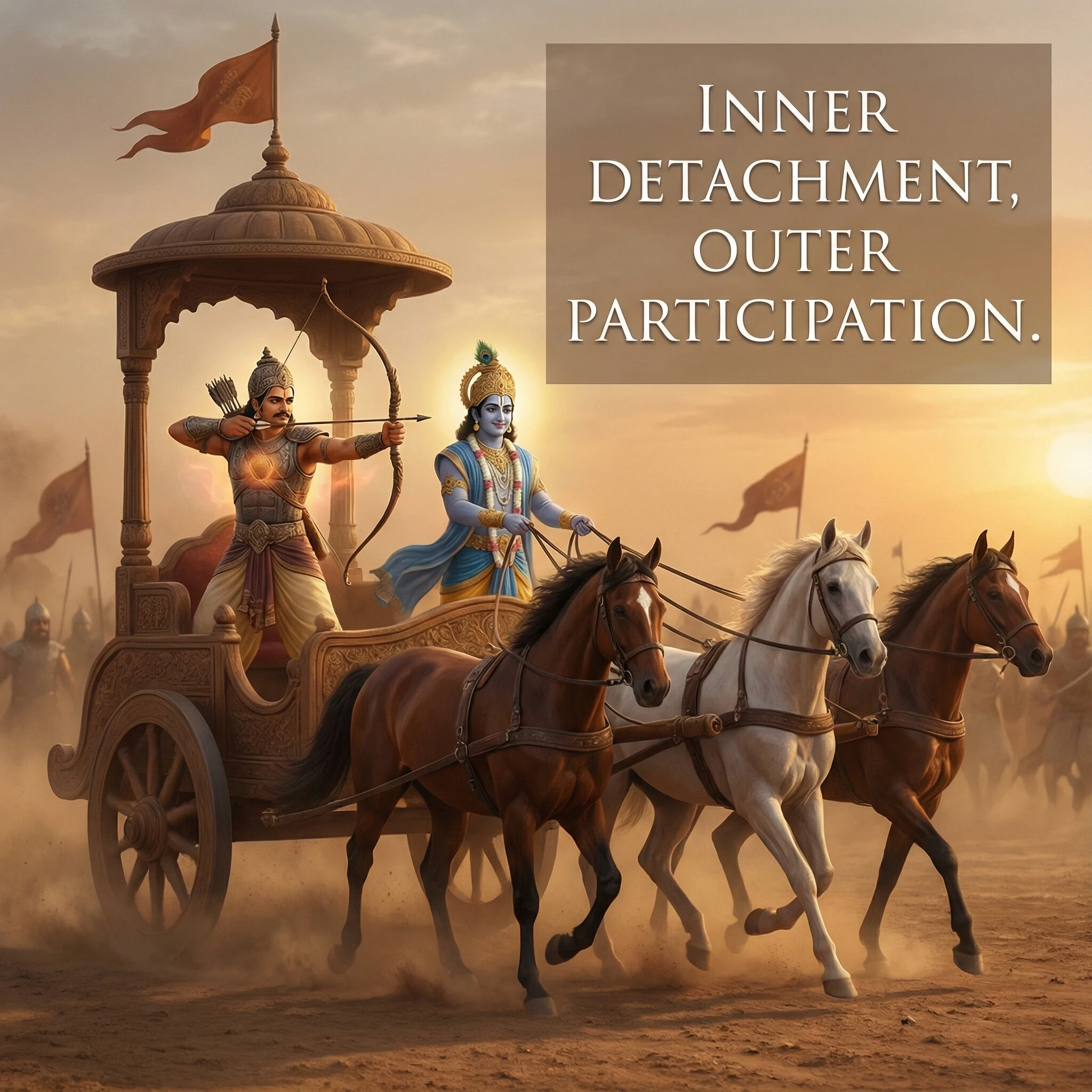
Healthy detachment is actually really active. You’re still caring, feeling, and choosing. The difference is, you don’t let every thought or emotion jerk you around like a puppet on strings. Krishna calls this state being established in yoga, which simply means union with your true Self even while acting in the world.
So when something stressful happens, I’m not forcing myself to not feel anything. Instead, I try to notice the stress, label it, and respond from a place of awareness instead of automatic reaction.
It’s like being on a big ship. You feel the waves, and you still steer, but you’re not tossed overboard every time there’s a swell. This puts you in a way better position to handle problems and connect with people calmly. It leads to steadier decisions and more genuine responses, because you’re not caught up in whatever the mind spits out every minute.
This is exactly what Arjuna needed on that battlefield. He needed to act, but he couldn’t act clearly because his mind had taken over. Krishna’s teaching freed him to engage fully without being controlled by fear, grief, or confusion.
This is what makes the Gita’s approach different from simple withdrawal or passive acceptance. Krishna teaches Arjuna to see through the mind’s noise so he can act from clarity, not fear. The goal isn’t to escape life but to participate in it fully from the right inner place.
Practicing healthy detachment can actually deepen your relationships and help you make wiser choices. You start responding to difficult conversations with empathy instead of lashing out, and you recognize when your mind is just spinning a story rather than telling the truth. Over time, this brings a quiet confidence and a steadiness that others notice too.
Common Misunderstandings
I’ve run into a few misunderstandings when talking about this whole teaching, so let me clear those up quickly with some real-life examples:
Misunderstanding one: You have to stop thinking completely. That’s just not how the mind works. Even longtime meditators have thoughts. The Gita never asks us to destroy the mind or make it totally blank. The point is to see thoughts as separate from who you are, to establish yourself in the position of the witness rather than getting lost in the content of thinking.
Misunderstanding two: You should avoid emotions. This teaching isn’t about being numb. For example, if you feel sad, the healthy move is to notice it and allow it, not bottle it up. Recognizing you aren’t the mind gives space to feel emotions honestly without being overwhelmed or defined by them. Krishna himself displays compassion throughout the Gita. Detachment from the mind doesn’t mean detachment from caring.
Misunderstanding three: You need to withdraw from daily life. You can fully participate in work, relationships, and everything else. Krishna tells Arjuna to fight, to do his duty, not to run away to a cave. The Gita’s guidance just helps you not be run by unhealthy thoughts or emotional swings. I still pay bills, answer emails, and get annoyed at traffic like anyone. Now, I just try to witness my mind’s reactions instead of becoming them.
Another misunderstanding: Practicing this creates indifference or apathy. Actually, stepping back from your mind lets you engage with more compassion and less defensiveness. You notice angry thoughts without instantly acting on them, opening space for kindness. This is an important distinction: detachment means freedom, not disconnection.
How This Teaching Connects to Modern Psychology
If all this sounds a lot like new trends in psychology, you’re right. The practice of seeing thoughts as thoughts has big overlap with cognitive defusion, from Acceptance and Commitment Therapy, and metacognition, which means thinking about how you think. Both encourage noticing thoughts without getting lost in them. Another related idea is the “observer self,” which lines up directly with the Gita’s concept of the sakshi or witness.
Modern science and ancient wisdom often arrive at the same spot, just through different routes. Plenty of research shows that being able to step back and observe your thinking can reduce anxiety, boost resilience, and improve mood. That’s why skills like mindfulness get taught everywhere from therapy sessions to corporate offices.
For me, knowing the Gita’s teachings are backed up by modern findings just makes them even more valuable for daily life.
For example, in studies on mindfulness meditation, participants who practiced observing their thoughts without attachment reported lower levels of rumination and felt more in control of their emotions.
Therapies like DBT (dialectical behavior therapy) and MBSR (mindfulness-based stress reduction) are now common ways people learn to work with thoughts in healthier ways. These modern approaches echo the ancient lesson Krishna taught Arjuna thousands of years ago on that battlefield.
The connection isn’t surprising when you think about it. Human minds haven’t changed much over millennia. We still face the same basic challenge Arjuna faced: how to act clearly when the mind is pulling us in a hundred directions.
Whether the wisdom comes from an ancient Sanskrit text or a modern psychology lab, the solution points to the same capacity we all have: the ability to step back and witness our own mental activity.
Short Practice from the YouTube Lesson
Krishna’s lesson becomes much more real when you actually try it. That’s why I recorded a short guided experiment you can do right now:
Watch the guided practice video on YouTube or below.
In the video, I walk you through a gentle exercise to notice thoughts as they rise up and shift your attention back to awareness. No need to sit cross-legged or be super spiritual. Just a few minutes of your time.
If you watch along and follow the instructions, notice how your mind settles even briefly. Repetition makes the benefits stronger over time.
Link to the Previous Bhagavad Gita Lesson
This post is just one part of my full Gita series, checking out lessons for living more clearly. If the idea of separating yourself from the mind clicked for you, I strongly recommend returning to the first lesson on You Are Not the Body.
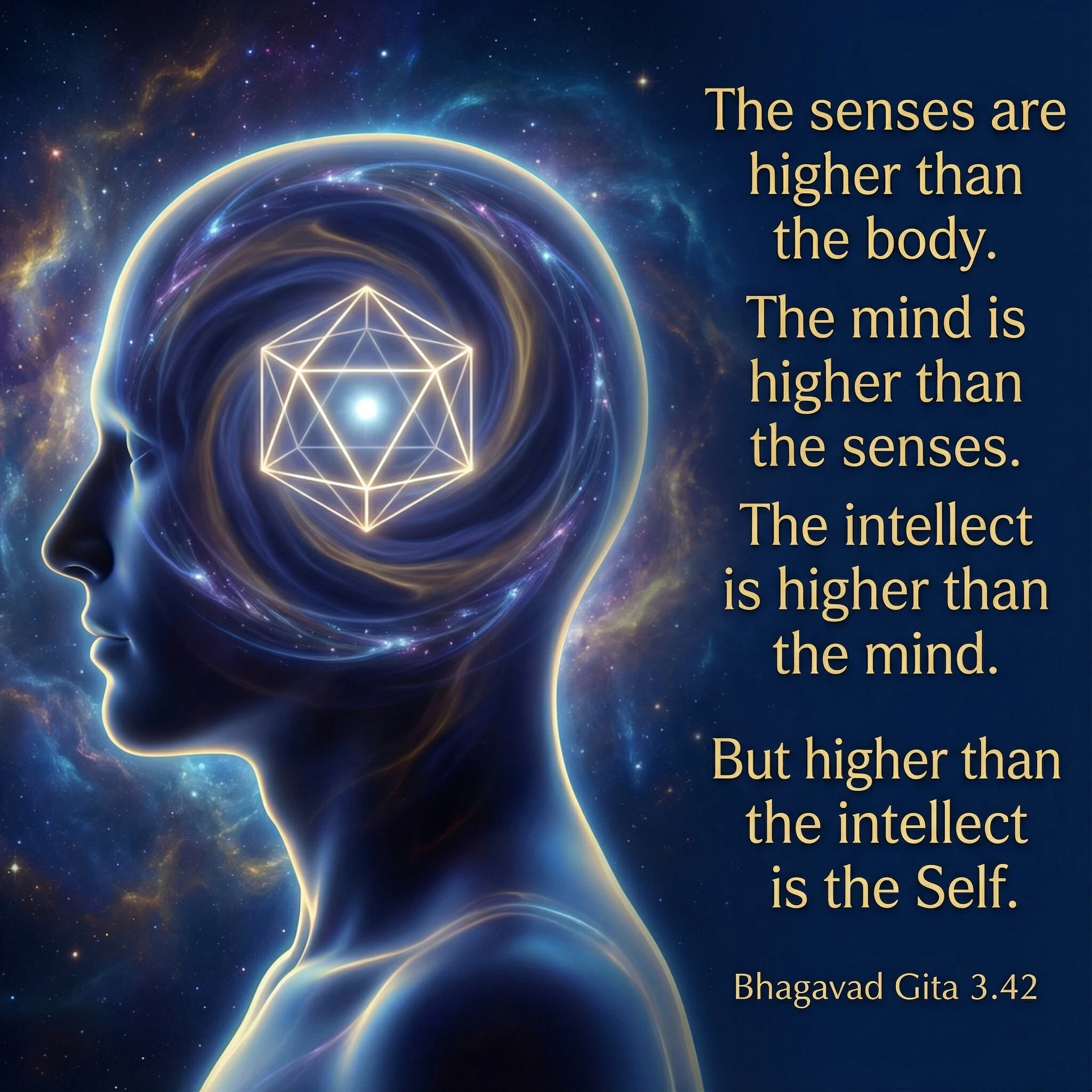
Seeing how these teachings build on each other helps put the whole picture together so you get a much deeper and more practical sense of these ancient ideas. In the Gita, Krishna first helps us see that we are not just the physical body, then shows how the mind and its emotions are subtler layers, and finally points beyond them to the deeper Self. In one key verse (Bhagavad Gita 3.42), he even lays out a clear inner hierarchy—from body and senses to mind and intellect, and then to the Atman—which mirrors this step‑by‑step journey inward. Each lesson builds toward a steady sense of self that is less shaken by the chaos of thoughts and feelings.
FAQ
What does the Gita mean by not being the mind?
It means your real nature, called the Atman, is the awareness or the witness that notices thoughts, not the thoughts themselves. Krishna teaches this to help Arjuna step back from his mental confusion and reconnect with his unchanging Self.
How can I detach from thoughts without suppressing them?
Try observing them gently, labeling them, and returning to the present, without fighting or ignoring them. The Gita teaches that the mind can be steadied through practice and detachment, not through force.
Can I still think normally while applying this teaching?
Absolutely. You keep thinking, but you see thoughts with a little more distance and calm. Krishna didn’t ask Arjuna to stop thinking. He asked him to stop identifying with thoughts so completely.
What’s the first step to realizing I’m not the mind?
Simply notice a thought as it arises and realize there’s an awareness behind it doing the watching. This is the beginning of discriminative awareness (viveka in Vedanta), the ability to see the difference between Self and not‑Self.
Does this overlap with mindfulness?
Yes, mindfulness and the Gita’s teaching both point to watching thoughts without getting caught up in them. The Gita’s concept of the sakshi, or witness, aligns closely with the observer self in modern mindfulness practice.
Can I use this approach during stressful times?
Definitely. In fact, stressful moments are the ideal time to gently shift your attention to the witness, to recognize thoughts as temporary and not who you are at your core. This is exactly what Krishna taught Arjuna during his most overwhelming moment.
Is this practice religious?
No, it’s rooted in philosophy and awareness. Anyone from any background can try it and benefit. While the Gita comes from the Hindu tradition, the insights about mind and awareness are universal.
Wrapping Up
Every day brings new thoughts, challenges, and feelings, but understanding this teaching from the Bhagavad Gita means you get to watch the show without getting swept away by every scene. The more you practice noticing your thoughts instead of merging with them, the steadier and more peaceful life feels.
Krishna taught Arjuna this lesson at a moment of total crisis, when everything seemed impossible and the mind was screaming with doubt and fear. The teaching worked then, and it works now. The same witnessing awareness that helped Arjuna find clarity on the battlefield can help you find clarity in your daily life.
That is why the “you are not the mind Bhagavad Gita” teaching remains one of the most practical and powerful insights for modern life.
If you’re interested in checking out more, keep following along with the Daily Self Wisdom series. I’m happy to walk this learning adventure with you, and I hope each step brings you a little more freedom from the internal chatter, and a lot more inner peace. Try the awareness test once a day for a week and journal what you notice.

Chris is the voice behind Daily Self Wisdom—a site dedicated to practical spirituality and inner clarity. Drawing from teachings like Eckhart Tolle, Ramana Maharshi, and timeless mindfulness traditions, he shares tools to help others live more consciously, one moment at a time.Learn more about Chris →
Leave a Reply