If you have ever found yourself genuinely unsure whether something is intuition or just anxiety dressed up as wisdom, you are in good company. This question comes up in the most ordinary moments: deciding whether to take a new job, knowing when to reach out to someone, or figuring out whether a quiet inner nudge means something real. For anyone who has spent time paying attention to their inner experience, sorting out these signals can get confusing in ways that are hard to describe.
Anxiety has a way of mimicking genuine inner guidance, especially when overthinking is your default setting. One moment you sense a pull toward or away from something, and the next your mind is off running through a hundred reasons to second-guess yourself. Learning how to trust your intuition over anxiety is not just about feeling better. It genuinely makes daily decisions cleaner and reduces the kind of regret that comes from letting fear call the shots.
I have found in my own practice that the difference is subtle at first, but it becomes much easier to spot with time. Getting familiar with these two inner signals means you are less likely to ignore the quieter guidance that actually tends to steer you well. And it is worth saying early on: learning to differentiate intuition from anxiety is a skill, not a personality trait. That means it is available to anyone willing to pay attention.
This article walks through what intuition and anxiety actually feel like, how anxiety tries to disguise itself as your inner voice, practical ways to tell them apart, how presence helps settle the noise, and what teachers like Ramana Maharshi have observed about the deeper source of genuine knowing. There are also some hands-on exercises, everyday practices, and a short Q&A toward the end. By the time you finish, you will have a clearer sense of how to navigate these inner signals with a bit more ease.
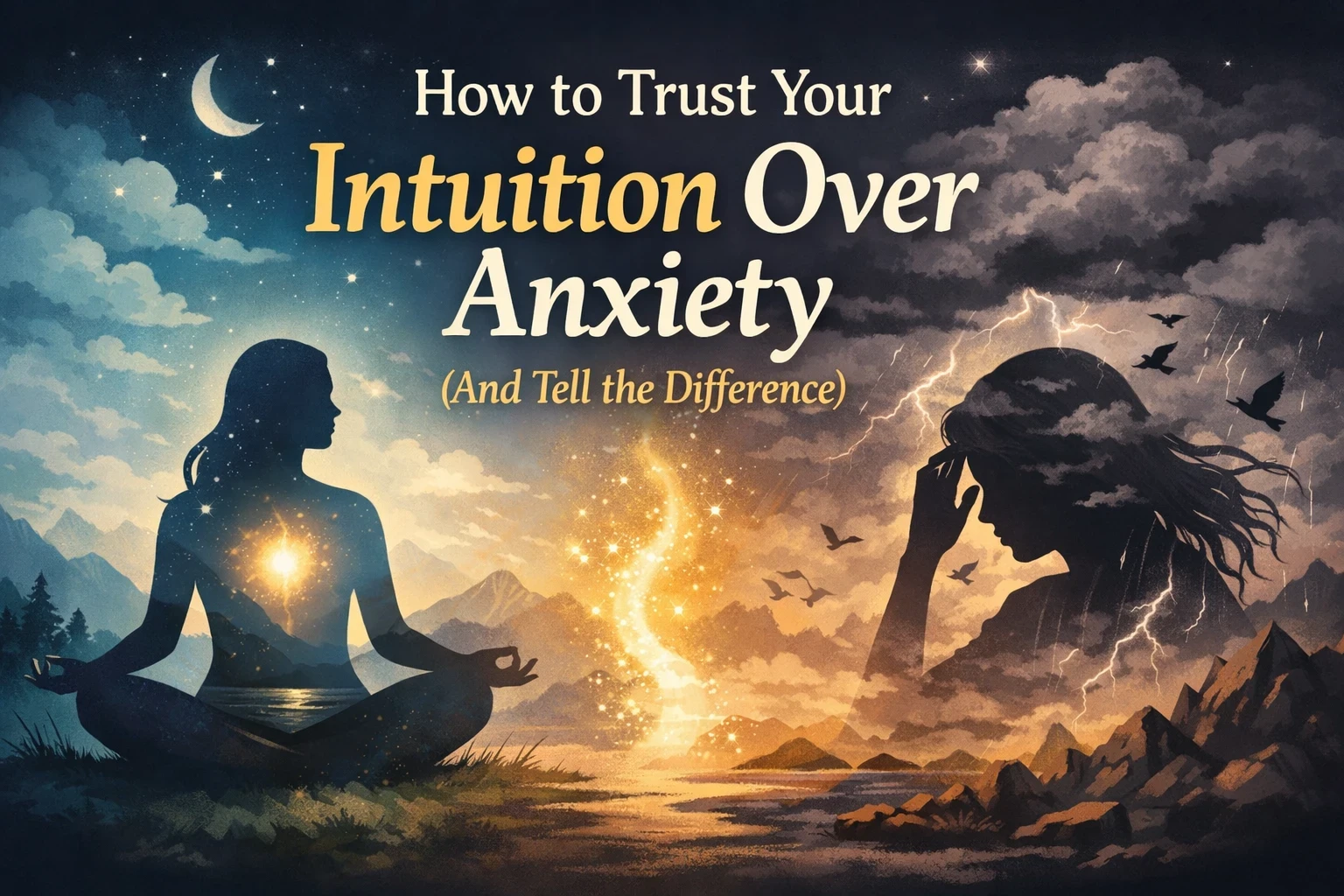
What Is Intuition vs Anxiety?
It helps to start with what these two actually are. Even though both show up in your inner experience, intuition and anxiety feel quite different when you learn to pay attention.
Intuition
Intuition is a quiet inner knowing. There is no urgency to it, no dramatic emotional charge. It tends to arrive as a gentle nudge or a settled sense that something is true, without requiring explanation. Often it comes before the mind has had a chance to analyze anything.
It does not repeat itself compulsively. In my experience, intuition usually says something once and then waits. It does not push.
• It feels calm and direct, even when the message involves something significant.
• It often arrives quickly, before rational analysis kicks in.
• It does not usually come packaged with fear or urgency.
If you have ever just known you should not take a particular route, or felt compelled to check in on a friend at exactly the right moment, that is the quality of intuition. It is almost unremarkable in how quietly it arrives.
Anxiety
Anxiety is something else entirely. It is the thinking mind working hard to manage uncertainty, predict danger, or prevent pain. The signals it sends are louder and more persistent.
• It loops. The same thoughts come back again and again, often with more intensity.
• It lives in hypotheticals. What if this goes wrong? What if I make the wrong choice? What if I regret this?
• It creates urgency. There is a pressured feeling that a decision needs to be made right now, or something bad will happen.
Say you are weighing up a travel decision. A quiet, settled sense of “this is not the right time” is more likely intuition. But if you keep cycling between dread, worst-case imagining, and relief that shifts back to dread, that is anxiety in charge.
At least for me, the clearest distinction is this: intuition feels like something is simply being noticed. Anxiety feels like the mind is trying to solve something it cannot quite reach. Pausing for even a few seconds to check which one is active can already change how you respond.
How To Differentiate Intuition From Anxiety
Talking about the general difference is one thing. But in the middle of a real decision, when things feel murky, you need something more concrete. Here is what I tend to look for when I am trying to sort them out in myself.
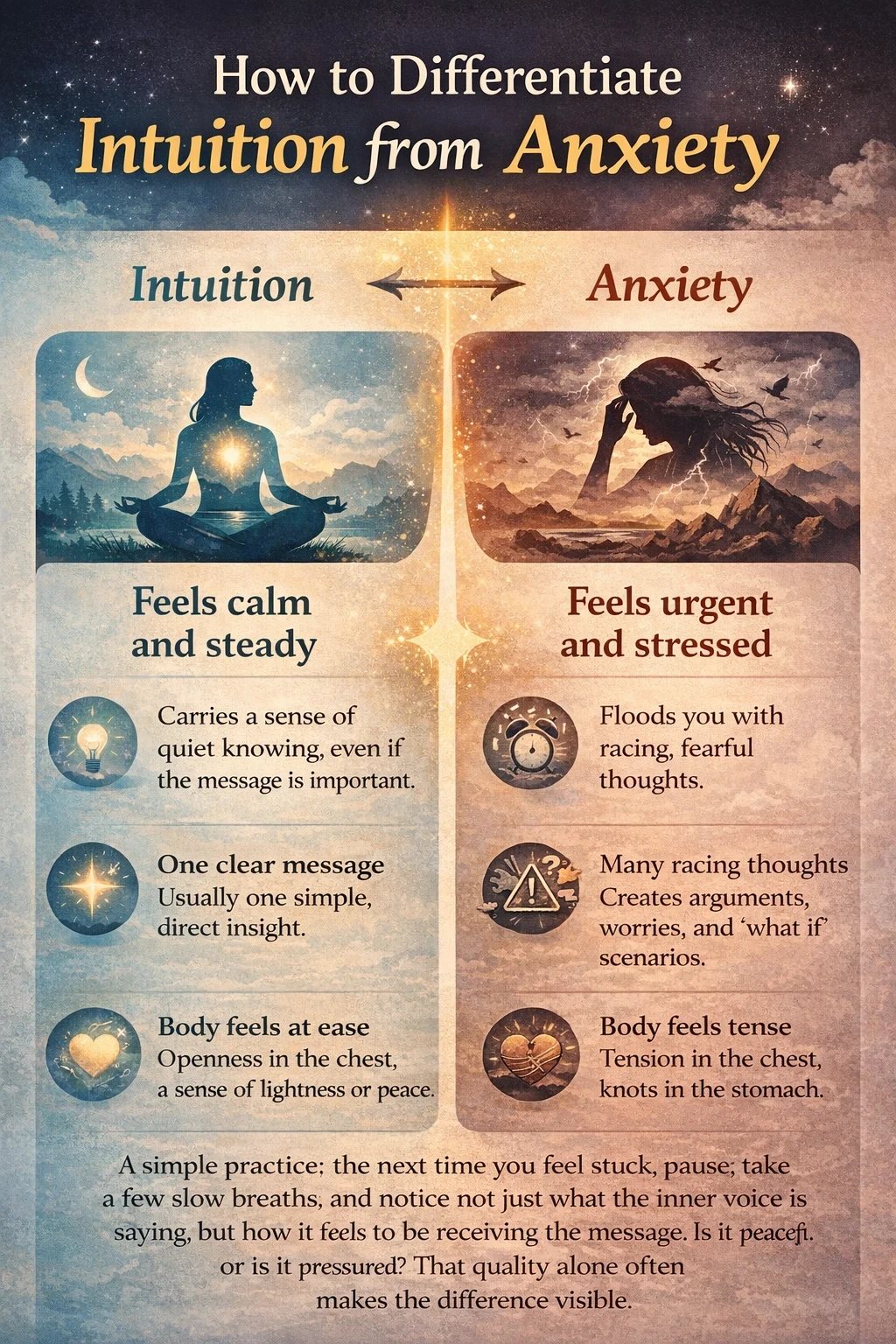
Intuition feels steady, even when the message is about something big. It carries a quality of simple awareness rather than alarm. Anxiety, on the other hand, tends to come with a racing quality, a sense of tightness or pressure, and an urgency to resolve things immediately.
Intuition usually delivers one clean signal. It does not negotiate or pile on arguments. You might sense something like “reach out to that person” or “give yourself more time,” with very little extra commentary attached. Anxiety multiplies. It brings options, counter-arguments, new scenarios, and then circles back to where it started. The sheer volume of mental noise is often a giveaway.
Something else worth noticing is the physical dimension. Intuition often comes with a subtle openness, a kind of ease in the body, even if the message is challenging. Anxiety tends to show up as tension in the chest, a knotted stomach, or a heaviness that is hard to place. These physical cues, taken alongside the quality of your thoughts, can tell you quite a lot.
A simple practice: the next time you feel stuck, pause, take a few slow breaths, and notice not just what the inner voice is saying, but how it feels to be receiving the message. Is it peaceful, or is it pressured? That quality alone often makes the difference visible. It takes some patience at first, but each time you do it, the pattern becomes easier to recognize.
Techniques For Balancing Intuition And Anxiety
It is tempting to wish intuition would just speak up more loudly. But from what I have observed, intuition is actually fairly constant. The problem is that anxiety is rowdy and tends to drown everything else out. The goal, then, is not to force intuition to the surface, but to create enough quiet for it to be heard.
Pause and breathe. This sounds almost too simple, but slowing down even for a few seconds genuinely shifts the internal atmosphere. Closing your eyes, feeling your feet on the floor, and taking three slow breaths can move you from a reactive, anxious state into something quieter and more spacious. I come back to this again and again.
Notice anxious thoughts without following them. There is something useful in learning to observe anxious mental chatter without immediately engaging with it. Think of it like watching a train pass: you can see it, hear it, even acknowledge it, but you do not have to get on. Letting anxious stories run in the background without reacting to them takes practice, but it loosens their grip considerably.
Once the mental noise settles even slightly, there is often an intuitive sense that steps forward on its own. It is a bit like turning down a loud radio and discovering someone was talking quietly in the next room all along. What remains tends to be obvious and undramatic.
Changing your setting can also help. Stepping outside, even briefly, has a way of interrupting anxious loops and giving intuitive clarity a bit more room. Nature in particular has a settling effect that is hard to explain but easy to verify for yourself.
Writing things out is another option worth trying. Putting anxious thoughts on paper externalizes them, which often frees up space inside. Once the swirling is on the page rather than in your head, it is much easier to notice what is left beneath the noise.
Steps To Manage Anxiety And Improve Intuition
When everything feels tangled, a more structured approach can help. This is roughly the process I return to when I find myself caught between anxious noise and genuine inner signal.
First, recognize when anxiety is looping. Simply naming it quietly to yourself, something like “that is anxiety talking,” is already a meaningful interruption. Identifying specific patterns, catastrophizing, replaying a conversation, projecting into the future, disrupts the automatic momentum of those thought cycles.
Second, move your attention away from the story and toward something grounded. Feeling your hands, noticing the temperature of the air, or simply looking around the room and observing what is there, these simple acts pull attention out of the head and into the present moment. It is hard to stay in an anxious spiral when your attention is actually here.
Third, allow thoughts to settle before making any moves. Most significant decisions do not actually need to be made immediately, even when anxiety insists they do. Waiting, without trying to solve anything, often allows clarity to arrive on its own.
Fourth, notice what remains once the mental dust settles. This is usually where intuitive clarity shows up. Sometimes it is a clear sense of the next step. Sometimes it is simply a recognition that more time is needed. Either way, whatever is left after the anxious noise quiets tends to be simpler and easier to trust.
Finally, ask for a reality check if you need one. Talking through your experience with someone you trust can offer useful perspective when the inner landscape feels too murky to read on its own. There is nothing weak about wanting a second opinion.
What Ramana Maharshi Teaches About Inner Knowing
If you are drawn to a more contemplative perspective on this, the teachings of Ramana Maharshi offer something genuinely useful here, and you do not need any background in Indian philosophy to appreciate it.
Ramana’s core observation was that the thinking mind is constantly producing thoughts, and that most of us are so identified with this stream of thoughts that we mistake the noise of the mind for the whole of our inner life. What he pointed to instead was something more fundamental: a quiet awareness that is always present, underlying all the mental activity.
His main tool was self-inquiry. When anxious thoughts arise and feel overwhelming, the practice is simply to ask: “To whom do these thoughts arise?” or even more directly, “Who is aware of this thought?” That question does not demand an intellectual answer. It redirects attention away from the content of the thought and back toward the awareness observing it.
This is where the connection to our topic becomes clear. Anxious thoughts belong to the thinking mind, the part of you that is trying to manage, predict, and protect. Self-inquiry shifts attention back to the awareness that is watching all of that. From that quieter vantage point, the mental noise naturally begins to settle, and what remains is closer to what Ramana would call genuine knowing.
He also emphasized that this kind of inquiry is not about analyzing your problems more carefully or weighing pros and cons more thoroughly. It is about seeing through the restless, fear-driven quality of anxious thinking itself, so that the simpler, steadier inner guidance that was always there becomes easier to notice.
Ramana taught that this deeper awareness is not reserved for spiritual practitioners or people with years of meditation experience. It is the natural ground of all human experience, accessible to anyone willing to turn attention inward rather than continuing to follow every thought that arises.
Practical Example: A Simple Test
Theory is useful, but most people need something they can actually try. Here is a small exercise I use often, particularly when a decision feels tangled or when I am unsure whether what I am feeling is intuition or anxious chatter.
Sit somewhere comfortable and close your eyes. Spend a minute simply settling, without trying to figure anything out. Then bring the situation you are uncertain about gently to mind, not to analyze it, just to notice what arises.
Ask yourself honestly: is what I am feeling calm and clear, or is it urgent and repetitive? Does it feel like something is simply being noticed, or does it feel like the mind is working hard to solve something?
Then wait a little before doing anything. Let the mental activity run its course without trying to speed it up or resolve it. Most of the time, sitting with that pause for even two or three minutes will reveal quite clearly which signal you are dealing with.
If you are facing a bigger decision, repeat this process over a few days. Patterns become visible with a bit of time and space. An anxious thought tends to keep changing shape and intensity. A genuine intuitive sense tends to remain consistent, even quiet, across different moments.
Building Confidence: Turning Intuitive Insights into Action
Even when you can clearly sense the difference between anxiety and intuition, there is still the matter of actually trusting what you sense enough to act on it. Doubt has a way of creeping back in, particularly if second-guessing yourself has been a long-standing habit.
One of the most practical things you can do is start small. Use low-stakes everyday choices as a training ground: what to eat, who to reach out to, which route to take. Check in with your intuition before deciding, choose based on whatever sense feels calm and clear, and then pay attention to how things unfold. Over time, this builds a kind of personal track record. You start to accumulate evidence that your own inner guidance system is actually working, which makes it considerably easier to trust it when larger decisions arrive.
Keeping a journal of these experiences adds another layer. Note moments when you had a hunch, followed it, and things turned out well. Note moments when you overrode it and later wished you had not. Neither entry is a failure; both are information. When you look back over those notes after a few weeks or months, patterns tend to emerge that would have been invisible in the moment.
The goal is not to become infallible. Intuition does not guarantee perfect outcomes, and there will be times when you get it wrong or when the signal is genuinely unclear. What grows with practice is not certainty, but a kind of quiet confidence in the process itself: the ability to pause, settle, listen, and move forward with a bit more ease than before.
Frequently Asked Questions
How can I tell if something is intuition or anxiety?
Intuition tends to feel neutral and steady, even when it is pointing toward something significant. There is a kind of settled quality to it, a sense of simple recognition without a lot of emotional turbulence attached. Anxiety, almost without exception, carries urgency and fear. It loops, it multiplies possibilities, and it rarely offers any lasting relief. When in doubt, pay attention to the energy behind the thought rather than just its content. Trust the message that arrives quietly and without a swarm of arguments following it.
Can anxiety ever look like intuition?
It can, and this is part of what makes this skill worth developing carefully. Anxiety sometimes presents itself as a strong inner voice, especially if past worries have occasionally turned out to be well-founded. The difference is in the quality: a truly anxious signal will keep escalating your stress, repeat itself with increasing urgency, and tend to be focused on controlling or preventing something. Genuine intuition is almost boring in its directness. It states something once, quietly, and does not demand immediate action. If what you are hearing feels panicked and overwhelming, anxiety is likely the source. If it slips in calmly and leaves you feeling strangely settled, even when the message is challenging, that is closer to intuition.
Does meditation help strengthen intuition?
It genuinely does, though not in any magical way. Meditation creates consistent windows of mental quiet, and in those quieter moments the intuitive signal that was always present simply becomes easier to notice. Even a short daily practice of five or ten minutes makes a real difference over time, not because it grants you a new ability, but because it gradually lowers the background noise level. If you are new to meditation, guided recordings or apps can be a useful starting point. Even simply sitting quietly and following your breath for a few minutes each morning counts.
What does spirituality say about intuition?
Across a wide range of spiritual traditions, intuition is understood as a natural inner wisdom that belongs to everyone, not a special gift reserved for certain people. Whether it is described as the inner voice, the heart, or the deeper self, the consistent teaching is that it is reliable when you have learned to distinguish it from the noise of anxious thinking. These traditions generally encourage the development of self-awareness as the foundation for that discernment, and Ramana Maharshi’s self-inquiry practice is one of the clearest expressions of that approach.
What if I do not feel intuitive at all?
That is more common than people realize, particularly if you have spent a long time in a high-stress or high-anxiety mode. Intuition does not disappear, but it can become very difficult to detect when the mind is constantly busy. The first step is simply creating small gaps in the mental activity, even just a breath between thoughts, or two quiet minutes before your day begins. Intuition tends to peek through in those moments. It may be subtle at first, and easy to dismiss. But the more often you create those pauses and pay attention, the more recognizable it becomes.
Conclusion
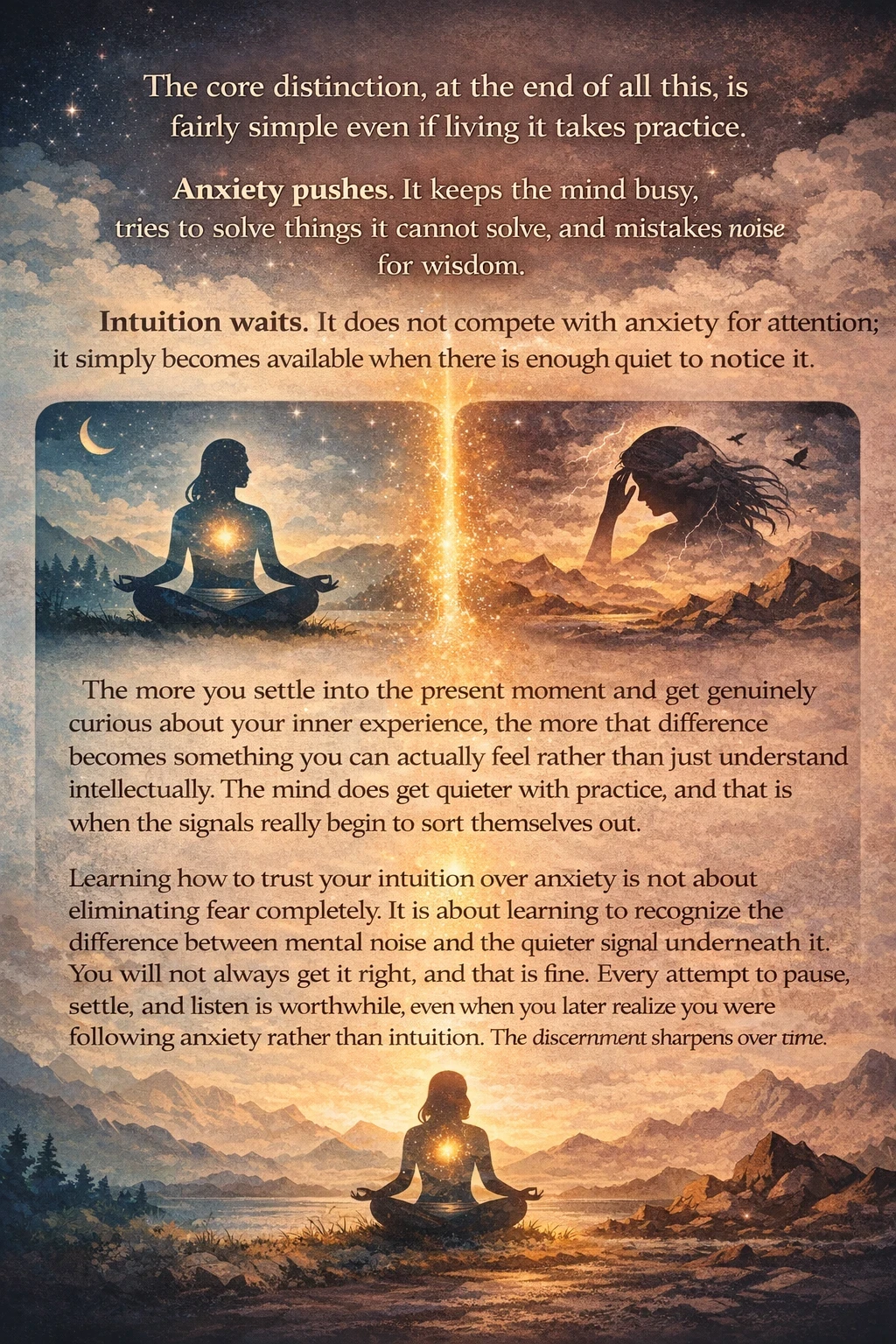
The core distinction, at the end of all this, is fairly simple even if living it takes practice. Anxiety pushes. It keeps the mind busy, tries to solve things it cannot solve, and mistakes noise for wisdom. Intuition waits. It does not compete with anxiety for attention; it simply becomes available when there is enough quiet to notice it.
The more you settle into the present moment and get genuinely curious about your inner experience, the more that difference becomes something you can actually feel rather than just understand intellectually. The mind does get quieter with practice, and that is when the signals really begin to sort themselves out.
Learning how to trust your intuition over anxiety is not about eliminating fear completely. It is about learning to recognize the difference between mental noise and the quieter signal underneath it. You will not always get it right, and that is fine. Every attempt to pause, settle, and listen is worthwhile, even when you later realize you were following anxiety rather than intuition. The discernment sharpens over time. What grows is not perfection but a kind of grounded confidence in your own inner compass, and that makes a genuine difference in how you move through daily life.
If you ever find yourself lost in anxious mental noise, the simplest thing is always available: pause, breathe, and come back to what is actually here. Clarity tends to follow. Not always immediately, and not always neatly, but consistently enough that the practice is worth keeping.
Explore Practical Ways to Quiet the Mind
If the difference between intuition and anxiety interests you, you may find these related guides useful. Each one explores a practical aspect of reducing mental noise and reconnecting with the deeper awareness that sits quietly beneath your thoughts.
● How to Stop Overthinking and Return to the Present Moment
● How to Practice Self-Inquiry Without Turning It Into Thinking
● Presence vs Mindfulness: What’s the Real Difference?
Each of these articles builds on what is covered here. They offer simple, grounded ways to become more aware of the mind’s activity and recognize the quiet clarity that is already there beneath it.
If you would like to see how Ramana Maharshi’s self‑inquiry actually looks in practice, this short video walks through the method step by step in everyday situations. It is a simple way to experience how turning attention back to awareness itself can quiet anxious mental noise and make intuitive knowing easier to recognize.

Chris is the voice behind Daily Self Wisdom—a site dedicated to practical spirituality and inner clarity. Drawing from teachings like Eckhart Tolle, Ramana Maharshi, and timeless mindfulness traditions, he shares tools to help others live more consciously, one moment at a time.Learn more about Chris →
Leave a Reply