Late at night, after a long day, it’s easy to end up on the couch, phone in hand, face lit by the blue glow of an endless “up next” carousel. Whether it’s Netflix, Spotify, or just trying to pick a dinner spot on a food delivery app, the experience is almost always the same. Scroll, scan, hesitate, until it’s unclear whether a choice was actually made or you just gave up. That weird restlessness feels like the opposite of freedom. All these options seem to close in instead of opening anything up.

The Paradox of Choice Explained
Turns out, there’s a name for that overwhelmed feeling: “The Paradox of Choice,” a term popularized by psychologist Barry Schwartz. The core idea is simple enough. We assume more options mean more happiness and freedom, but the reality tends to play out differently. Too many choices lead to decision fatigue, regret, and anxiety.
Schwartz describes two kinds of decision-makers: maximizers and satisficers. Maximizers want the absolute best option every single time. Satisficers go with “good enough“; they pick what meets their main needs and move on. The problem for maximizers is that the more options there are, the harder it becomes to feel confident about the choice made. There’s a constant background hum: “What if something better is just one row down?” That quiet fear of missing out never fully goes away.
Once a decision is finally made, the second-guessing often starts immediately. If dissatisfaction creeps in, the reflex is to blame yourself for not finding the “perfect” choice. Small things, like picking which streaming show to start, can get weirdly stressful just because of the swarm of options surrounding them.
Why More Choice Feels Like a Trap
When every decision feels like it could be optimized, life starts to feel like a never-ending math puzzle. Overthinking grocery shopping, overanalyzing vacation plans, freezing up about what to say yes or no to socially. Choice overload doesn’t just slow decisions down. It quietly removes the enjoyment from choosing in the first place.
Online shopping is a classic example. Set out to buy something simple, like running shoes, and within minutes you’re knee-deep in browser tabs, comparing features, reviews, and color options. After all that research, you finally order a pair, then spend the next week wondering if another choice would have been better. The effort invested rarely matches the satisfaction felt afterward.
Career moves and relationships crank the stakes up even further. Swiping through dating apps, hunting for jobs, scrolling LinkedIn for career inspiration. It all creates a persistent feeling that whatever gets chosen might be wrong. It’s like standing in a hallway with doors on both sides. Open one, and all the others seem to slam shut for good.
Those everyday decisions leave people more stressed, more regretful, and emotionally drained. If you’ve ever replayed a decision in your head long after it was made, you know exactly what this feels like.
Where Psychology Stops Short
Barry Schwartz and a lot of modern psychology do an excellent job of explaining the “why” behind choice overload and decision fatigue. The usual advice that follows is to limit your choices, streamline your options, and simplify your routines. Those are useful tips, but they’re surface-level if your mind is still spinning with “what ifs.”
At a certain point, the real problem feels less like a logistics issue and more like something sitting underneath. All those options aren’t going away anytime soon. So instead of just changing the number of choices, the question shifts. Could the root of this anxiety be about how we relate to options, not just how many there are?
That’s where psychology tends to run out of road, and where a different kind of framework becomes genuinely useful.
Buddhist Non-Attachment: What It Actually Means

There’s a concept in Buddhist philosophy called nonattachment that tends to get a weird reputation. In practice, it’s pretty straightforward, and genuinely applicable here.
Nonattachment isn’t about being indifferent or checked out. It’s not “I don’t care what happens.” It’s about holding choices lightly instead of clutching them for dear life. The underlying Buddhist teaching is that craving leads to suffering. Needing things to turn out a particular way causes more stress than the situation itself. Nonattachment is the middle ground: you make a choice, you care about it, you put in real effort, and then you let go of the need for that choice to fulfill some flawless fantasy.
Buddhism sometimes calls this the Middle Way. Not chasing every desire until your brain is fried, but not ignoring all your wants and needs either. It’s the space where you can choose without getting lost in needing any single outcome to be perfect, or worrying that something better is lurking just out of reach.
Choice Overload and Attachment: The Real Connection
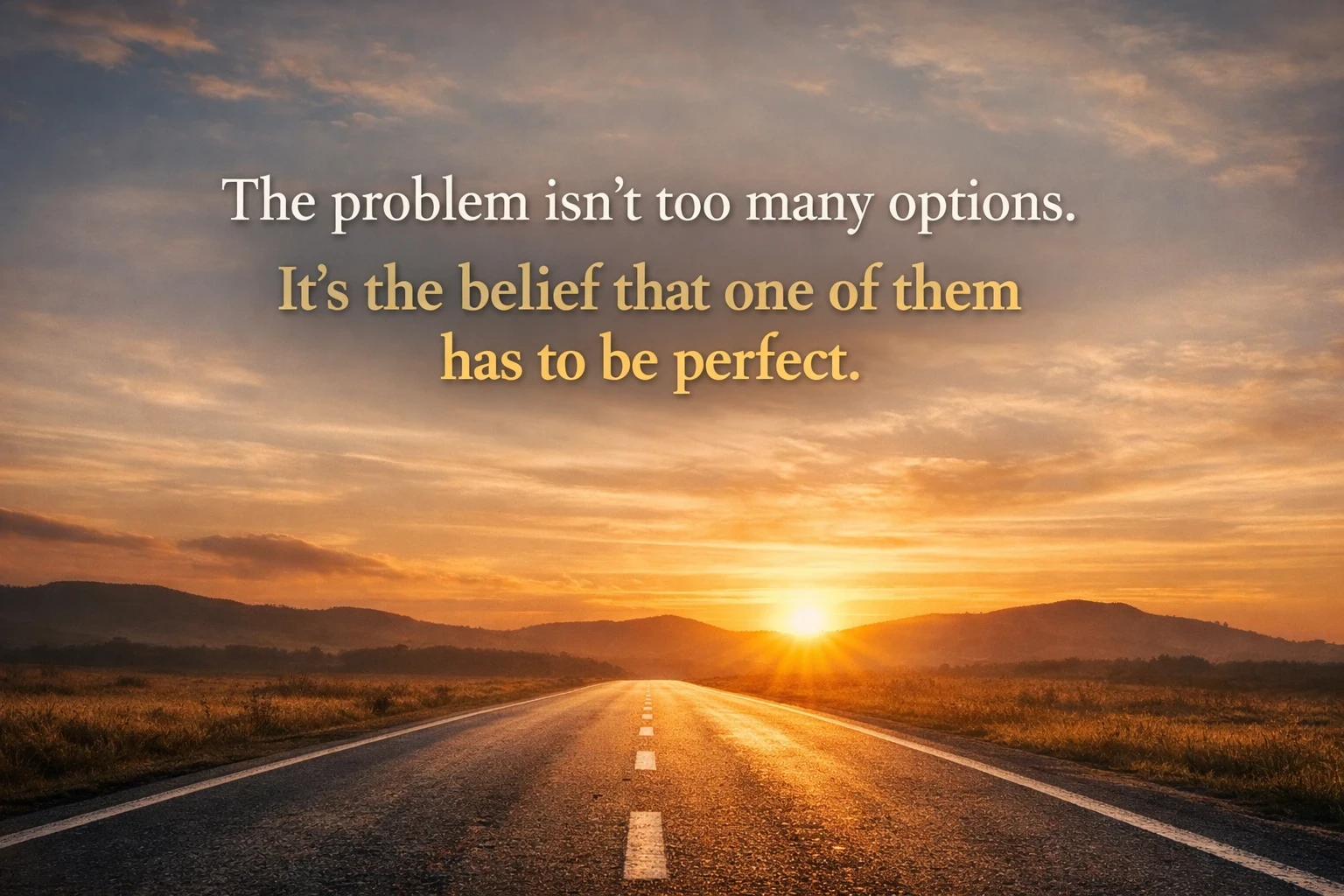
Here’s where things start to click. The stress of too many choices isn’t really about the choices themselves. It’s about the attachment to making the “best” one. There’s a belief, often unconscious, that peace only comes from picking perfectly every time. The suffering isn’t caused by the options. It’s caused by the expectation that one of them has to be the magic answer.
The problem isn’t too many options. It’s the belief that one of them has to be perfect.
The common mental loop goes: “What if I pick wrong? What if there’s something slightly better?” It’s a mental itch that can’t be scratched. But once you frame it as an attachment to needing the ideal outcome, the pressure loosens. Nonattachment in decision-making becomes permission to choose, learn from it, and move on, without the internal monologue running for days afterward.
Letting go of the expectation that any choice will check every box also dissolves a lot of regret. When happiness isn’t banked entirely on the outcome being flawless, imperfect results become manageable rather than personal failures.
Nonattachment in Everyday Modern Life
Practicing nonattachment during decision-making isn’t about checking out. It’s about being practical and present. In daily life, this often looks like settling on “good enough” when faced with too many options (lunch menus, weekend plans, which product to buy) and moving forward instead of obsessing over possibilities that won’t matter a week later. That’s not laziness. It’s sanity.
There’s a quiet confidence that comes with this shift. The investment in a decision is real, but it doesn’t spiral into a perfectionist tailspin. The focus moves toward what a choice actually provides, rather than the few things it leaves out. Think about something as small as picking a restaurant. With a nonattached mindset, you choose somewhere that sounds good, go, and experience the meal. Without it, you cross-reference reviews for forty-five minutes, second-guess the reservation, and arrive slightly resentful before you’ve even sat down.
Once a decision is made, it can live in the present rather than being replayed endlessly in search of a different ending. Nonattachment mostly feels like relief, like a pile of mental baggage finally set down.
Being nonattached doesn’t mean never changing your mind or never wanting to improve things. It simply means not tying your peace of mind to every tiny detail being exactly right.
From Maximizing to Letting Go: Moving Past Decision Anxiety
A maximizer mindset is exhausting. The search for “the best” can wear you out long before any actual results arrive. A nonattached approach isn’t about giving up on quality or ambition. It’s about stepping away from the endless chase for the “ideal.”
There’s a real freedom in just making a choice, owning it, and letting the rest go. Less regret, faster decisions, more actual enjoyment of what’s in front of you. No more years of research before pressing play on a film. No more existential hesitation over a menu. The pressure drops, and what remains is the experience itself, imperfect maybe, but real.
It doesn’t feel like a spiritual discipline. It feels like relief.
Frequently Asked Questions
Does nonattachment mean I shouldn’t care about results at all?
Not at all. Nonattachment still values effort and thoughtful decisions. It simply helps you avoid tying your self-worth and happiness entirely to how things turn out. You stay engaged, but a little looser with your expectations.
If I pick “good enough,” won’t I just settle for mediocre things?
Surprisingly, no. “Good enough” usually frees up time and energy for things that actually matter to you. And you tend to enjoy your choices more when you’re not constantly auditing them for flaws.
Can nonattachment help with regret about past decisions?
Definitely. Approach decisions with less pressure for perfection, and regret naturally fades. Even when something doesn’t work out, it becomes one data point in a much larger picture, not something to beat yourself up over.
The Takeaway
Life today is almost certainly going to keep offering more options, not fewer. The number of choices available isn’t the problem, and it isn’t going away. What can shift is the grip placed on finding the “perfect” one.
Even a small reduction in that attachment changes the texture of daily decisions. They become lighter, faster, and more enjoyable. Not because the options got simpler, but because the relationship to them changed.
Nonattachment isn’t a switch you flip. But even loosening the need to get everything exactly right changes how daily decisions feel. They become lighter, faster, and easier to live with. Not because the world got simpler, but because your relationship to it did.
Further Reading on Choice, Freedom, and Non-Attachment
If this way of looking at choice resonates, it’s worth exploring it a bit more deeply. The tension between freedom, decision-making, and inner peace shows up in different ways across psychology and spiritual traditions, but the underlying pattern is often the same.
Some books explore this from complementary angles, whether through modern psychology or practical approaches to presence and letting go.

Chris is the voice behind Daily Self Wisdom—a site dedicated to practical spirituality and inner clarity. Drawing from teachings like Eckhart Tolle, Ramana Maharshi, and timeless mindfulness traditions, he shares tools to help others live more consciously, one moment at a time.Learn more about Chris →
Leave a Reply