Too many options doesn’t just slow you down. It drains you. Not from the choices themselves, but from the mental pressure that builds around them, this constant pressure to get it right, pick the best one, not miss out, not waste the chance. By the time you’ve weighed five options, you’re already exhausted, and you haven’t even decided yet.
It shows up everywhere. Picking a productivity app, choosing a takeout restaurant, scrolling through a streaming library for twenty minutes only to give up. The moment everything feels important, nothing is clear anymore.
What I’ve found actually helps isn’t more research or better systems. It’s mindfulness, used practically, not philosophically. Not as a life overhaul, but as a set of small tools for dialing down mental noise and moving forward. Mindfulness helps you sort signal from static, keep your stress from spiking, and make choices feel lighter, without needing certainty you’ll never have.
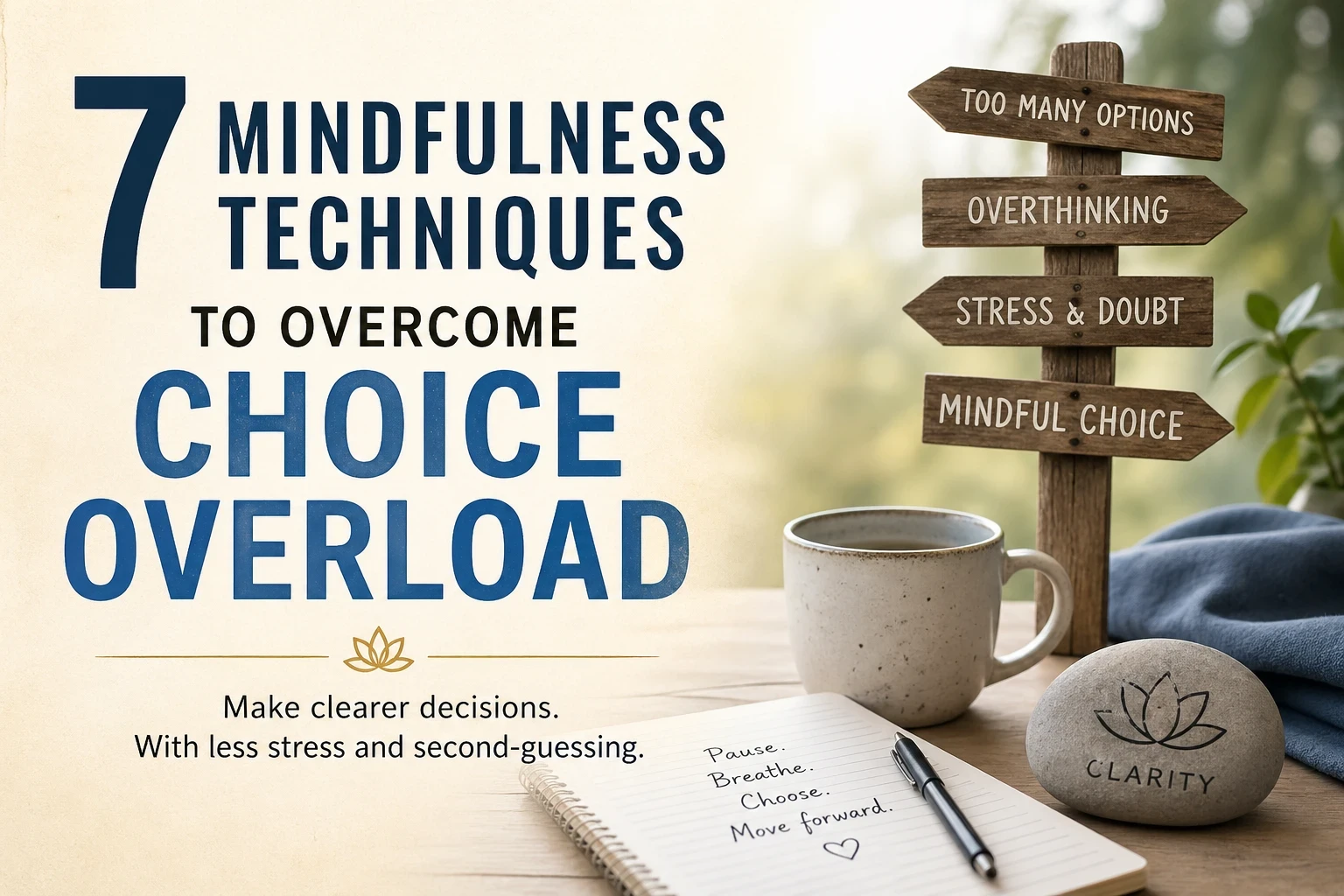
What Is Choice Overload and Why It Drains You
Choice overload is what happens when your brain gets swamped by too many options, big or small. Suddenly, picking lunch feels as hard as deciding what job to take. The mental weight just keeps building until it turns into full decision fatigue.
When I hit that wall, my energy drops fast. Small things feel impossible, and the mental spiral starts. Too many options, too many potential mistakes, too much effort spent on decisions that, in hindsight, didn’t actually matter that much. I’ve wasted ridiculous amounts of time trying to pick things that didn’t matter. The exhaustion is real, and it’s not a personal failure. It’s just what an overloaded mind does.
Mindfulness doesn’t cut your list of options in half. What it does is interrupt the flood of thoughts and feelings that make those options overwhelming in the first place. With some mindful awareness, you can catch yourself spiraling, notice the pattern, and reset, before you’ve burned through your whole afternoon staring at reviews.
1. Notice the Pressure Behind the Decision
For me, the stress rarely comes from the choice itself. It comes from this background pressure that there’s a right answer out there, and if I miss it, I’ll regret it. Every small decision starts carrying more weight than it should, and the stakes feel unrealistically high.
One of the most useful mindfulness techniques for choice overload is just pausing to notice that pressure. Not to solve it. Just to name it. Instead of rushing to analyze more options, I stop and let myself feel what’s actually there: a tightness in the chest, racing thoughts, the familiar voice that says hurry up.
In practice, that looks like this: I stop, acknowledge to myself that I’m feeling pressure to decide perfectly, and let that be okay. I sit with it for a minute instead of reacting. Even sixty seconds of that can take the edge off. Most decisions don’t need to be perfect. They just need to be made.
Most of the stress isn’t about the options. It’s about the story that one of them is the right one.
2. Switch from Thinking to Direct Awareness
When I’m caught in choice paralysis, my brain has one main strategy: replay the options again. Maybe this time it’ll click. It doesn’t. More thinking doesn’t produce clarity, it just creates more noise.
This is where mindfulness exercises for better decision making make a real difference. Instead of trying to think my way out, I shift attention to what I’m actually experiencing right now. The feel of my breath. My feet on the floor. The temperature in the room. It’s not escaping the decision. It’s letting the mental weather settle a bit so something clearer can surface.
Even thirty seconds of that before making a choice changes the quality of the decision. The urge to keep analyzing loosens. I stop second-guessing as much afterward. And I’m more patient with myself, which by itself reduces a lot of the associated stress. If your mind keeps looping even after you decide, that’s usually the same pattern behind overthinking, and it responds to the same approach.
You can’t think your way out of overthinking. You have to step out of it entirely, even briefly.
3. Limit Inputs to Simplify Decisions
Half the time, choice overload gets worse because of how much information I’ve let in. Reading every review, watching comparison videos, checking forums, none of it actually helps. By the end I’m more confused than I was at the start. The avalanche of opinions and ratings doesn’t clarify anything. It just adds more variables to an already crowded decision.
When I want to start simplifying life choices, I redraw the boundaries before I even start researching. That might mean picking three articles and stopping, or asking one person I trust for their top two recommendations instead of scrolling an endless list. The constraint itself is the strategy.
When inputs are limited, decisions get easier. And there’s something quietly satisfying about choosing what you let in, especially in a world that keeps pushing more at you. I’ve had times where I knew less at the end of an hour of research than I did at the start. More information doesn’t produce better decisions. It produces more hesitation.
4. Use Short Mindfulness Pauses Before Deciding
Mindfulness doesn’t require a cushion or a quiet room. Some of the most useful pauses I take are thirty seconds long, done wherever I am, right before a small trigger moment.
Before sending a message I’m not sure about, I stop and breathe. Before clicking buy on something I’ve been going back and forth on, I pause. Before replying to something that feels loaded, same thing. These aren’t meditations. They’re just brief interruptions that keep me from making reactive choices I’ll want to revisit.
A few slow breaths, shoulders dropping, a moment off the clock. Not clearing the mind completely, just resetting it enough to approach the next choice with a little more intention. Over time, those micro-pauses add up. My indecision starts burning less energy. I feel more satisfied with what I choose.
A thirty-second pause costs almost nothing. A reactive decision can cost a lot more.
5. Stop Trying to Make the Perfect Choice
Perfectionism is what keeps choice paralysis alive. Not the size of the options, not the complexity. It’s the quiet belief that somewhere in the pile there’s a flawless answer waiting, and that anything less than that is settling. That loop can run forever.
Overcoming choice paralysis isn’t about lowering your standards. It’s about recognizing that most decisions are reversible, adjustable, or just not as final as they feel. When I catch myself in that loop, I remind myself that any choice is better than staying frozen. The momentum itself has value.
In practice, this means letting myself pick a restaurant in two minutes, or starting on whichever task looks most ready, without agonizing over sequence. Good enough, chosen and acted on, gets you further than perfect, endlessly deferred.
Perfection is a moving target. “Good enough and done” is an actual place you can reach.
6. Reduce Digital Noise That Triggers Overload
Choice overload in digital environments hits differently because it’s so constant. Open tabs, push notifications, recommendation algorithms, every platform is designed to pull your attention toward another option. Before you know it, you’ve spent an hour bouncing between possibilities without landing anywhere.
My fix is simple: cut the clutter. I uninstall apps I don’t use, close most tabs, and limit notifications. Sometimes I switch my phone to grayscale for a day, which reduces the visual pull more than I expected. These aren’t dramatic changes. But they remove a lot of unnecessary micro-decisions that were quietly draining me.
When the digital environment is quieter, there’s just less to react to. Choices feel less urgent. And I notice I’m less anxious overall, not from any big intervention, just from having fewer triggers running in the background.
Every notification is a small decision you didn’t ask for. Fewer notifications, fewer invisible drains.
7. Trust Simplicity Over Endless Analysis
For a long time I thought more analysis meant better outcomes. It doesn’t. What it mostly produces is more doubt. My gut read of a situation, the first clear sense of yes or no, is often closer to right than the version I arrive at after twenty minutes of second-guessing.
These techniques to simplify decision-making come down to one thing: pick, then commit. I choose one answer, act on it, and I don’t reopen it unless something genuinely significant changes. Not because I’m certain, but because the freedom of a closed decision is worth more than the false comfort of keeping it open.
The confidence builds from repetition. Each time I act on a simple, direct read and it works out fine, it gets a little easier to trust that process next time. And when it doesn’t work out perfectly? I adjust. That’s allowed.
The problem isn’t choosing. It’s reopening the choice afterward.
How to Overcome Choice Overload with Mindfulness (Quick Recap)
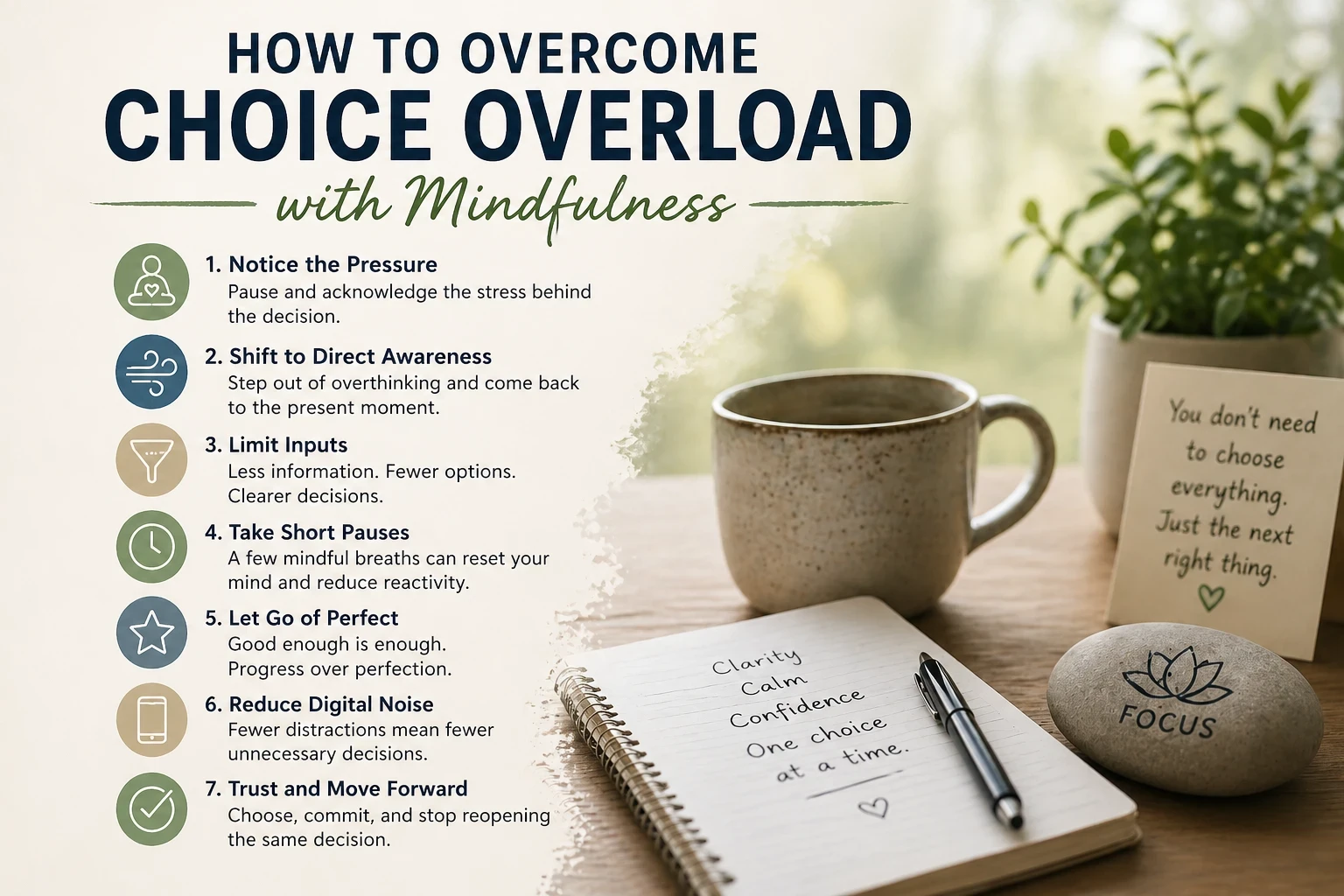
Mindfulness doesn’t erase your options. It removes the pressure and noise that make those options feel unbearable. Staying present, rather than chasing the perfect answer, makes daily decisions smoother. Lighter. Less costly to your energy.
Checking in with myself, taking short pauses, limiting inputs, accepting good enough: none of these are big changes. They’re small shifts that add up. Over time, they change the relationship you have with decisions entirely, less dread, more ease, less second-guessing, more forward motion.
FAQ
How to overcome choice overload with mindfulness?
By pausing to notice mental pressure, shifting focus to the present moment, and giving yourself permission to choose without perfection, mindfulness makes decision-making less stressful and more direct. Small consistent shifts add up fast.
What is choice overload mindfulness?
It’s using mindful awareness to catch yourself when you’re overwhelmed by too many options, then stepping back to let your mind reset before acting. Instead of overthinking, you check in with what’s actually happening inside and move forward from a clearer place.
How do I apply mindfulness to decision making?
Notice your thoughts and body when you start feeling stuck. Take a breath or two, limit new inputs, and give yourself permission to choose “good enough.” Most daily decisions can be simplified this way, and simplified decisions are almost always good enough.
What are the benefits of mindfulness for choice overload?
Less mental fatigue, lower anxiety, clearer thinking, and faster decisions you can actually stick with. You also stop doubting yourself as much afterward, which frees up a surprising amount of mental energy. Over time, you start building genuine trust in your own judgment.
Final Thoughts
Getting out of the choice overload cycle doesn’t require a big commitment. Try one thing: the next small decision you face today, pause for thirty seconds before you make it. Just breathe. Notice any pressure. Then decide. That’s the whole practice.
If these ideas resonate, it might be worth exploring self-inquiry more directly. Practices like Ramana Maharshi’s self-inquiry or the kind of presence Eckhart Tolle describes go deeper into the question of who is doing the choosing in the first place. That investigation doesn’t make decisions harder. It makes the whole relationship with thinking, pressure, and choice fundamentally simpler.
The goal isn’t a perfect decision-making system. It’s a calmer, more grounded relationship with the whole process.
If you want to go a bit deeper than just managing decisions and actually understand why the mind creates this pressure in the first place, these books helped me see it more clearly.
They’re not about adding more techniques. They’re about reducing the mental noise that makes even simple choices feel heavy.

Chris is the voice behind Daily Self Wisdom—a site dedicated to practical spirituality and inner clarity. Drawing from teachings like Eckhart Tolle, Ramana Maharshi, and timeless mindfulness traditions, he shares tools to help others live more consciously, one moment at a time.Learn more about Chris →
Leave a Reply