Jnana Yoga usually conjures up images of deep thinkers, closet philosophers, or people sitting with heavy texts and furrowed brows. Whenever I talk about it, the reactions tend to fall into two camps: those who think it’s all about complicated intellectual ideas, and those who assume it’s way too abstract for daily life. I felt the same way years ago. Confused and just a little skeptical.
But the more I explore the Bhagavad Gita, the more I notice that Jnana Yoga isn’t about thinking differently. At its core, it’s about seeing differently.
Jnana Yoga in the Gita isn’t a practice for escaping life. It isn’t mental gymnastics, and it doesn’t mean becoming cold or detached. Krishna presents it as a path for people who truly want to see what’s true, right in the thick of daily action.
This article strips away the usual cloud of abstraction. I’m focusing on what Jnana Yoga actually means as you live, work, deal with family, notice frustration, or just wash dishes. If you’re tired of theoretical answers and just want something real, this walk through the heart of the Gita is for you.
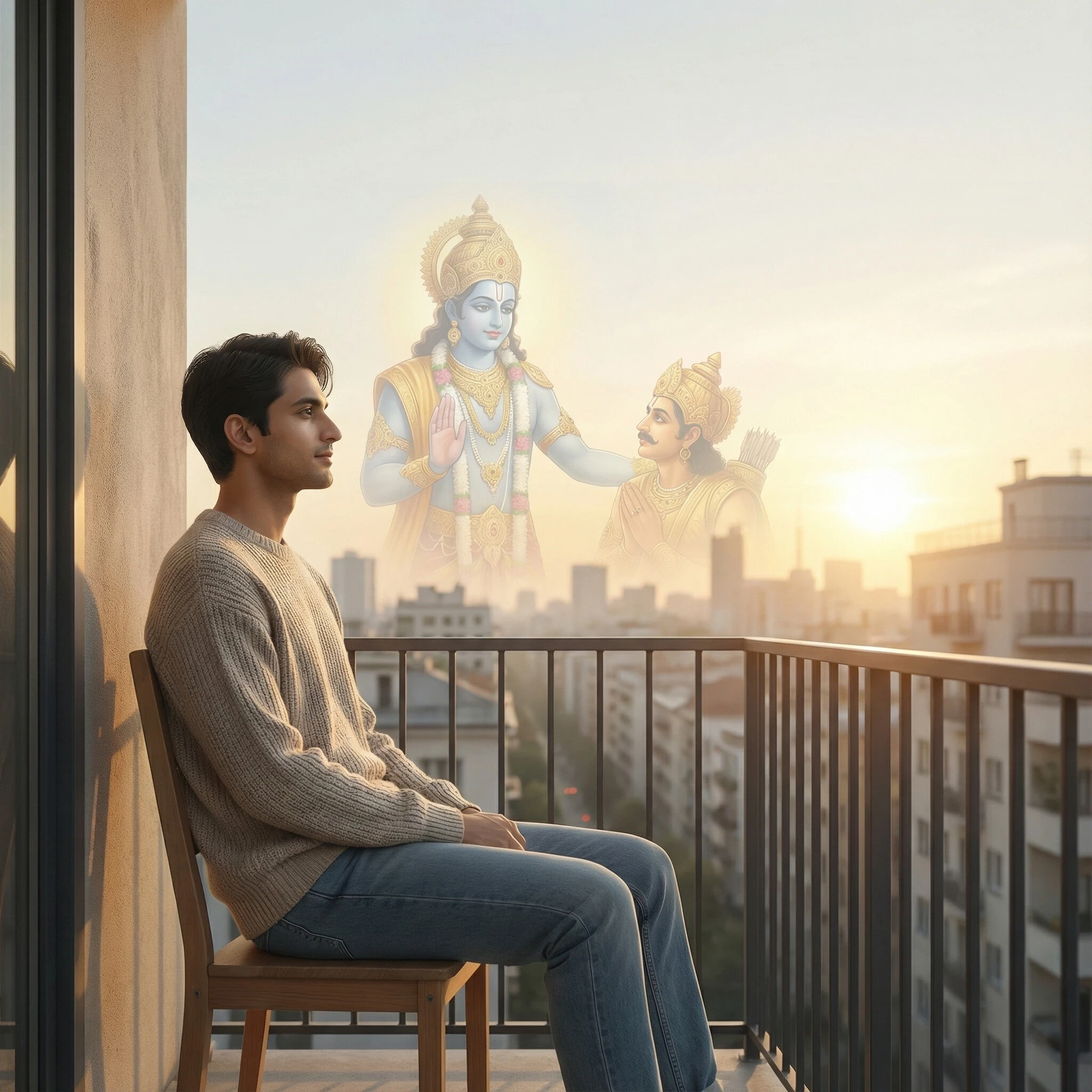
What Krishna Actually Means by Knowledge
Modern images of yoga often skip right over what Krishna actually points to when he talks about knowledge. When people hear “Jnana” (which just means knowledge), most immediately jump to thinking about reading or mulling over ideas. But Krishna’s version in the Gita isn’t about assembling ideas or debating philosophy. For him, the whole issue is much simpler, and honestly, much closer to home.
Knowledge, in Krishna’s lessons, isn’t stacked up against ignorance as a war of opinions. He’s talking about something much more practical: what we identify with as ourselves. Ignorance in this case basically means being confused about who or what we actually are. When I get swept up in my thoughts, urges, or moods, it’s not just a bad mood or a moment of anxiety. Krishna sees this as a lived misidentification, a very everyday kind of confusion.
What makes the Gita’s angle on Jnana Yoga different is that Krishna never says you have to withdraw from life to wake up to clarity. The daily grind, relationships, and even big life decisions are all, for him, the actual ground where real seeing-knowing happens. You can notice this seeing even when you’re stuck in traffic or in line at the grocery store. You don’t need to move away from the world. You just need to see yourself, right here, as you really are.
Jnana Yoga Video: The Practical Approach
Sometimes the mind ties itself up in knots trying to make sense of Jnana Yoga. That’s one of the main reasons I put together the YouTube video, Bhagavad Gita Lesson: Jnana Yoga and Freedom From Inner Disturbance. It covers how this type of yoga shows up in simple, practical moments. No robe, no retreat necessary.
If you’d rather see a hands-on look and hear examples about clarity in action, take a few minutes to watch it. This video breaks things down into plain language so it’s not mysterious or theoretical. If you ever wonder how Jnana Yoga applies on a day when you’re irritated, distracted, or anxious, this resource has your back. Feel free to watch it as you read through the rest of this article, since it connects directly to the sections below.
Jnana Yoga Is Not Philosophy (And Not Mental Analysis)
I’ve lost count of how many times I fell into the trap of treating Jnana Yoga as some sort of brain game. If only I could think well enough, maybe I’d be free. But chasing understanding through thinking is exactly the kind of mistake that keeps people on a treadmill.
The cornerstone truth? The mind can’t watch itself while it’s busy analyzing. However much you turn things over in your head, you end up right where you started.
Krishna points this out by constantly bringing things back to awareness itself. Jnana Yoga doesn’t live in the mind’s ideas. It happens in direct, present awareness. Concepts can point the way, but they’re not the same as seeing. When you notice thoughts coming and going, you’re already taking a step away from running on autopilot.
It’s common to accidentally turn “self-inquiry” into a game of endless self-interrogation. That isn’t what the Gita is about. Direct seeing is clear, simple, and effortless in a way that analysis will never be. If the mind is still spinning, you’re probably thinking, not seeing. Real Jnana Yoga is about what remains steady when all the thinking winds down. It’s seeing the mind’s activity, not just theorizing about it.
Jnana Yoga and Karma Yoga: There Is No Split
One of the weirder things I first noticed in modern yoga circles is the tendency to separate Jnana Yoga and Karma Yoga (the path of action) as if you have to choose between being a thinker or a doer. The Bhagavad Gita never makes that cut. Instead, Jnana Yoga and Karma Yoga weave together. One feeds and supports the other.
I’ve written in detail about why Karma Yoga (the yoga of action) isn’t a separate or lesser path. Action itself becomes a laboratory for seeing what you’re attached to, what you resist, and where confusion is hiding. You learn what you’re really seeing by how you act under stress.
In my own life, the biggest “Gita moments” haven’t happened sitting on a cushion but while navigating tense meetings or family messes. Knowledge, in the Gita, isn’t just information. It’s clarity that shapes how action happens. Action, on the other hand, makes murky attachments obvious, giving more space for seeing.
In the end, it’s not that you need to choose between Jnana and Karma. Real understanding lights up right in the middle of what you’re doing.
What “Seeing” Looks Like in Real Life

It’s easy to talk about “seeing” as if it’s some big mystical thing. For me, it shows up most when things are routine or even when they’re uncomfortable. Here are a few places I’ve noticed real Jnana Yoga doing its work:
1. Getting Caught in the Need to Be Right
The urge to win an argument or be seen as “correct” is a familiar trap. I catch myself constructing stories about why my view is best and subtly making the other person wrong. In that very moment, there’s a simple noticing: “My mind is trying to make me special or safe here.” That’s seeing. Thoughts keep popping up, but now there’s daylight between me and the habit. I don’t have to crush the urge, just see it clearly. The argument may go on, but something’s already shifted.
2. Anxiety About What’s Coming Next
This one hits home for a lot of people. My thoughts spiral about what could happen tomorrow, how things might go wrong, and what I should be doing to be more prepared. When there’s even a little awareness of that anxious churn, “There’s my mind, running off into future stories again,” I’m already seeing instead of just thinking. It doesn’t always make the anxiety vanish, but there’s a gentle clarity and sometimes even a bit of humor about it.
3. Trying to Do the Right Thing, But Still Feeling Messy
Sometimes I know what needs to be done: a tough conversation, admitting a mistake, or letting someone down gently. Even as I act, I might notice anger, fear, or the urge to run away. Jnana Yoga here isn’t about feeling pure. It’s about recognizing, “There’s resistance, and I’m still acting.” The mind may complain, and feelings may swirl, but awareness isn’t lost in the reaction. That presence creates space for genuinely responsible action, even if it feels raw.
4. Spiritual Practice Turns Into Self-Improvement Project
There are days when “working on myself” becomes just another way to chase some idea of perfection. If I step back and catch the underlying belief, “If I get better, I’ll finally feel okay,” that moment of seeing breaks the trance. The realization might just be, “Here comes the mind, wanting progress again, but nothing essential is improved or lost.” Pressure relaxes, and practice feels lighter.
5. Annoyance and Resistance in Everyday Life
Little frustrations like waiting for slow service, a noisy neighbor, or spilled coffee are where Jnana Yoga really gets practical. Watching the initial flare-up (“This shouldn’t happen!”), I sometimes notice the automatic grasping for control. If I just pause and observe, “That’s irritation happening,” the heat doesn’t own me. There’s no need to suppress it. It passes on its own, often more quickly than if I’d tried to fix or fight it.
Jnana Yoga and the Core of the Gita: Misidentification, Not Concept
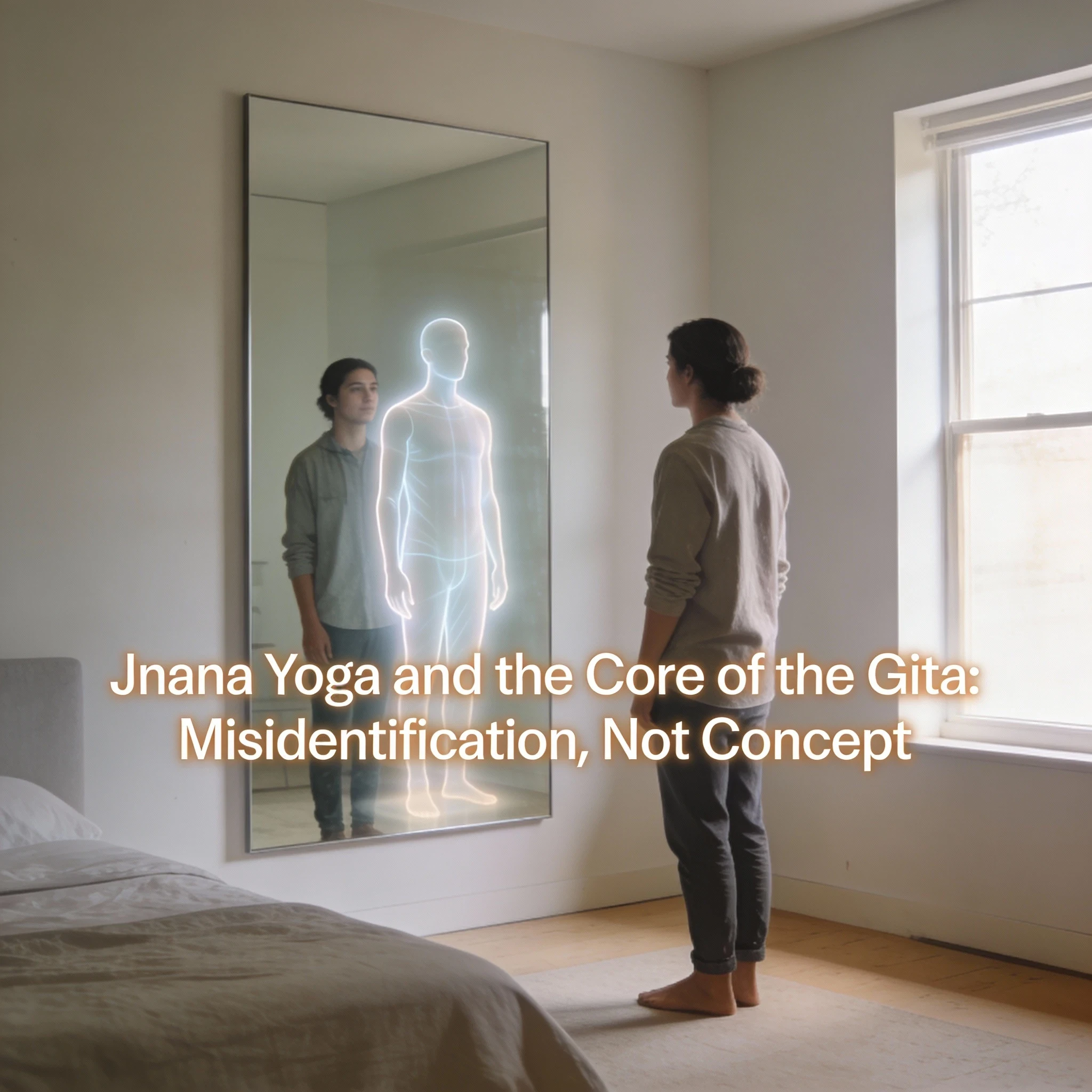
Over and over, the Gita boils things down to one repeating theme: suffering happens because I keep confusing myself with what I’m feeling, thinking, or experiencing. Krishna offers simple reminders:
These aren’t just ideas or fancy statements to memorize. They’re reference points for what happens when I genuinely see. I notice pain, but I’m not swept away. I notice planning, but I know I’m not the plan. As these recognitions settle in, life gets a lot less claustrophobic and much more workable.
The Gita invites you to test this in real, ordinary moments, instead of just believing it as a doctrine. You can explore how this works day to day in the articles You Are Not the Body and You Are Not the Mind, both of which look at what it really means to be free of these automatic identifications. That isn’t a new belief you tack on. It’s a living recognition that colors even the small moments of your day.
Where the Mind Gets Stuck With Jnana Yoga
If you’re like most thoughtful seekers, you’ve probably noticed that mental inquiry can become its own kind of prison. Here are some familiar sticking points I’ve run into again and again.
Inquiry turns into non-stop thinking: asking “Who am I?” without ever pausing to listen or notice the answer that’s already present. Or there’s the chasing after a special state of clarity, peace, or rising above, as if it’s a rare gem hidden somewhere out of reach. And then there’s using understanding as a way to sidestep real discomfort or emotional tension, thinking, “If I understand this enough, I won’t have to feel it.”
If these sound familiar, it’s totally normal. The Gita doesn’t judge these missteps. It quietly encourages simple seeing whenever the loop starts. When I catch myself turning seeing into a grind, I remind myself that clarity is usually simpler and softer than I expected. The “aha” moments happen in the middle of what’s actually in front of me, not as a reward for extra effort.
Jnana Yoga as a Living Practice: Simplicity, Not Methods
After decades of trying to stack up techniques and approaches, I keep returning to something the Gita suggests quietly. Jnana Yoga as lived clarity isn’t another tool to wield. It’s what’s already in play the moment I notice resisting, identifying, or getting lost in stories. No need for extra methods, tools, or retreat centers. Noticing, even once in a while, is enough to change the feel of a whole day.
There’s no badge or checklist for “doing Jnana Yoga.” If you step back for an instant and see that you’re swept up in hope, pride, guilt, or confusion, you’re already living the heart of what Krishna is teaching. In the classic lines of the Gita, wisdom isn’t hidden in monasteries or philosophies. It’s alive in the ordinary, right here, right now.
Jnana Yoga as the Heart of the Gita
If you’d like a copy of the Gita
What keeps me coming back to the Bhagavad Gita again and again is its fresh, clear invitation: live with clarity, not just cleverness. Jnana Yoga isn’t some advanced philosophy for the bookish. It’s available, practical, and alive in even the most boring or stressful moments.
If anything here resonates, I recommend revisiting the linked articles on Karma Yoga, You Are Not the Body, and You Are Not the Mind. For a more hands-on feel, catch the YouTube video I shared earlier. It weaves all these threads together with honest examples.
This article lays the groundwork for the whole Bhagavad Gita journey here at DailySelfWisdom.com. Everything else about the Gita makes more sense through the lens of Jnana Yoga as lived, steady seeing. You don’t have to get lost in big theories. Real seeing is only ever a breath away.
If this article helped clarify what Jnana Yoga actually points to, you may also want to explore Self-Inquiry in Action: Bringing Gita Insight into Daily Experience. That piece looks more closely at how this kind of seeing shows up moment to moment, especially when inquiry meets real situations, reactions, and habits.

Chris is the voice behind Daily Self Wisdom—a site dedicated to practical spirituality and inner clarity. Drawing from teachings like Eckhart Tolle, Ramana Maharshi, and timeless mindfulness traditions, he shares tools to help others live more consciously, one moment at a time.Learn more about Chris →
Leave a Reply