If you’ve ever found yourself cycling through browser tabs, answering messages while only half-reading an article, or scrolling your phone through dinner, you already know the feeling. For a long time, I convinced myself that keeping many things in motion at once meant I was getting ahead.
It took a while to see that what felt like progress was mostly spinning wheels. The multitasking myth is pervasive, and it’s surprisingly easy to miss because it disguises itself as hustle. Here’s what’s actually happening in your brain, what it costs you over time, and why deliberately doing less tends to produce better results.
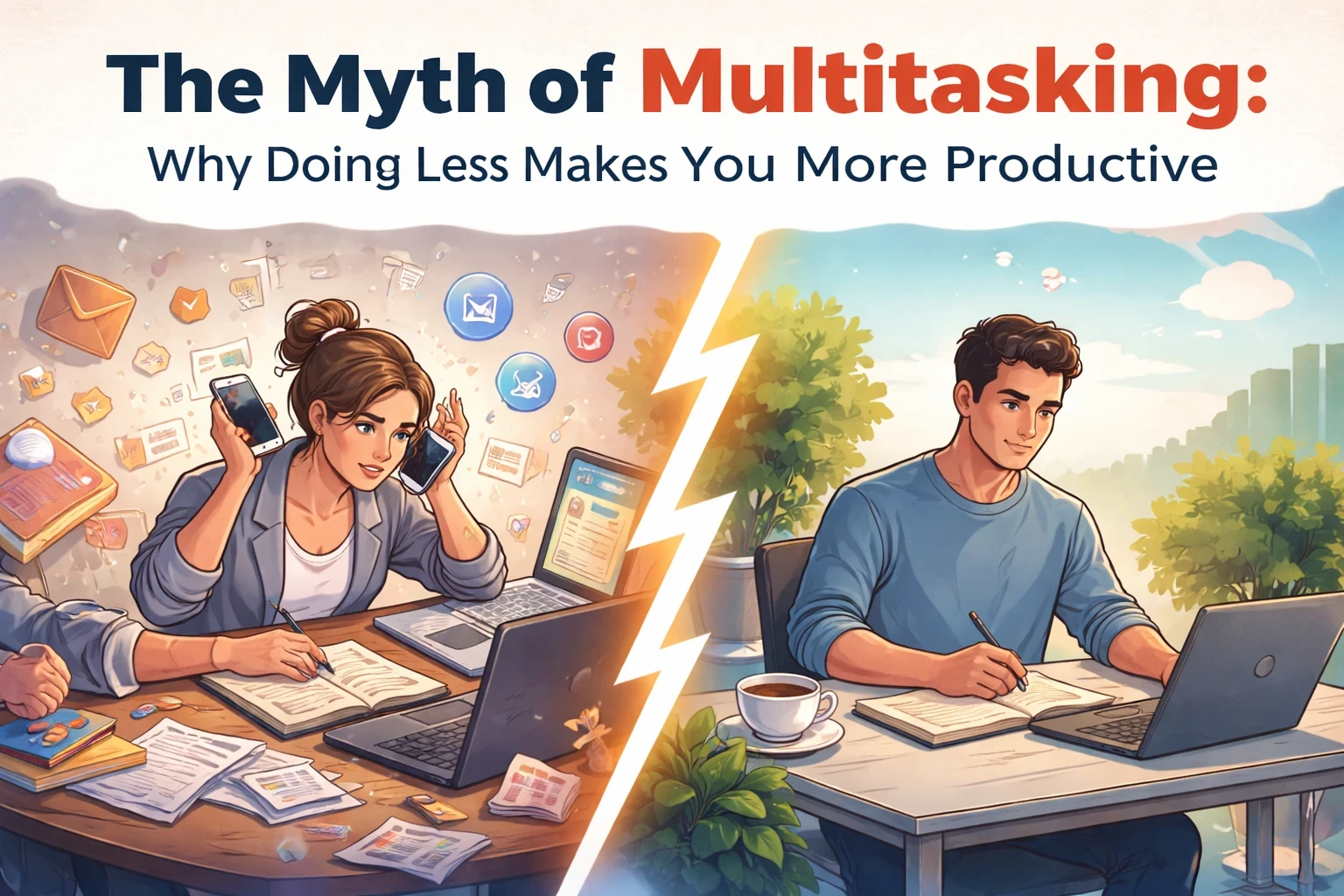
Multitasking doesn’t make you more productive. It just makes you more distracted.
What Multitasking Really Is (And Why It Feels So Effective)
Most people think of multitasking as handling several things at once. The brain doesn’t actually work that way. What we call multitasking is really task-switching: you start something, a notification pulls you away, you respond, drift back to the original task, then get snagged by another thought. Back and forth. Every switch requires the brain to unload one set of context and load another, and that costs more than we realize.
It feels productive, though. You’re clicking, responding, moving fast. Every completed micro-task releases a small hit of dopamine, which your brain reads as reward. A quick sense of “I got something done” kicks in, and before long you’re caught in a loop of activity that mimics productivity without quite being it.
The problem is that clearing small tasks fast doesn’t automatically move your real priorities forward. The illusion of progress is convincing, especially when your to-do list looks just as long at the end of the day as it did at the start. I’ve lost entire afternoons to email and felt strangely accomplished afterward, only to realize that nothing meaningful had actually moved.
The Science Behind the Multitasking Myth
The multitasking myth debunked comes down to how attention actually functions. Researchers use the term “attention residue” to describe what happens when you shift between tasks. Even after you’ve moved on to something new, a portion of your mental energy is still processing the previous item. You think you’re fully present on the new task, but your focus is split at a level you don’t consciously notice.
This isn’t a minor inconvenience. Study after study shows that people who work on multiple things simultaneously end up slower and make more errors than those who stick to one thing at a time. Even small interruptions, like a quick phone check, are enough to break your concentration and degrade the quality of what you’re doing. The science behind multitasking makes this plain: the cost shows up in the details. Writing gets clunkier, decisions get less careful, and mistakes slip through that wouldn’t have otherwise.
Why Multitasking Drains Your Energy and Focus
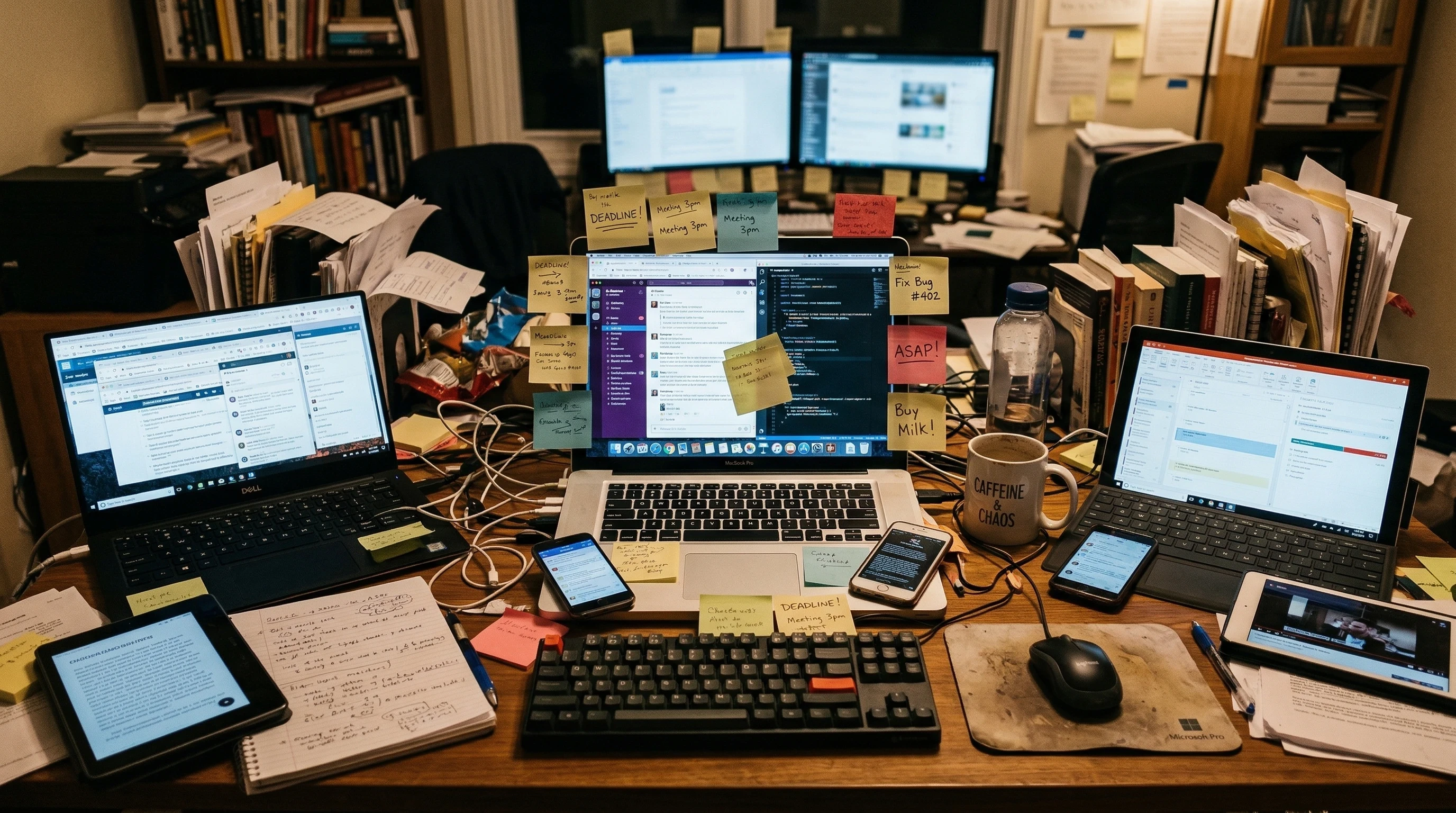
Constant context-switching burns through mental fuel faster than almost any other work habit. Every gear change, from one task to another, draws from the same limited cognitive reserve. This is why some days feel completely exhausting even when nothing about them seemed particularly demanding. The 3 p.m. mental crash often has less to do with the difficulty of your work than with how many times you switched tracks.
Part of what makes this so draining is the gap between shallow and deep work. Shallow work is the surface-level stuff: emails, chat messages, quick skims, routine replies. It keeps you busy but leaves you oddly unsatisfied. Deep work is something else entirely. It’s what happens when you stay focused long enough for your thoughts to actually settle into the problem. That’s when good thinking happens, when real progress gets made.
How multitasking affects mental health isn’t just about fatigue. There’s an emotional dimension too. Trying to track everything at once leaves a kind of low-grade restlessness that’s hard to shake even after work ends. Research links chronic multitasking to higher stress levels and a persistent feeling of being scattered. The more you try to keep up with everything, the less you actually enjoy anything you’re doing.
Multitasking vs. Single-Tasking: What Actually Works
There’s a version of productivity that looks impressive from the outside but produces mediocre results. Bouncing between editing, meetings, idea lists, and messages all afternoon might feel dynamic, but the quality of output almost always suffers for it. Multitasking vs. single-tasking isn’t really a close comparison when it comes to work that requires real thought.
Single-tasking consistently wins on the metrics that matter.
Faster completion: Focusing on one task without interruption allows you to finish it more quickly than if you’d split your attention. The switching costs add up fast.
Better quality: When all your attention goes to one thing, you catch more details, make fewer errors, and produce work that’s less frustrating to revisit.
Less stress: There’s a real calm that comes from finishing something before moving to the next. The sense of having “open loops” nagging at you from the background largely disappears.
Single-tasking doesn’t mean slow. It means working in a way that actually produces what you’re aiming for.
The Hidden Cost: Burnout, Overthinking, and Lost Presence
The multitasking myth doesn’t just hurt your productivity. It quietly shapes how you experience your day. When you’re constantly flipping between tasks, your mind is always carrying unfinished business. That load builds into anxiety. You find yourself second-guessing whether you’re doing enough, whether you’re missing something, whether the next urgent thing is about to arrive. The mental noise doesn’t stop just because you’re technically done for the day.
What also gets eroded is presence. When your attention is always split, you stop fully experiencing what’s in front of you. Simple things, tasting your food, genuinely listening to someone, noticing how a moment feels, get muted because some part of your mind is always somewhere else. Presence isn’t a meditation technique. It’s just the ability to be where you actually are. Multitasking thins that out until the hours start blurring together and very little registers as truly lived.
How Single-Tasking Naturally Leads to Presence
Single-tasking doesn’t just improve your work. It changes how your mind feels during the day. When you’re not being pulled in multiple directions, thoughts naturally slow down. You don’t have to force concentration. It settles on its own when the constant noise is removed.
Staying with one task long enough to finish it brings a quiet satisfaction that scattered busyness rarely offers. The urge to jump to the next thing fades. You notice small details, occasionally find something interesting in the work itself, and arrive at the end of a task feeling calmer rather than depleted. Over time, this carries over into how you think and learn. The mind that isn’t constantly interrupted has space to process, connect ideas, and occasionally come up with something it wouldn’t have reached under pressure.
Even in conversations, giving someone your undivided attention for a few minutes creates more genuine connection than hours of distracted half-presence. Building the habit of single-tasking is also, in a quiet way, building mental resilience. You’re training your attention rather than letting it be fragmented by whatever arrives first.
Practical Methods to Stop Multitasking
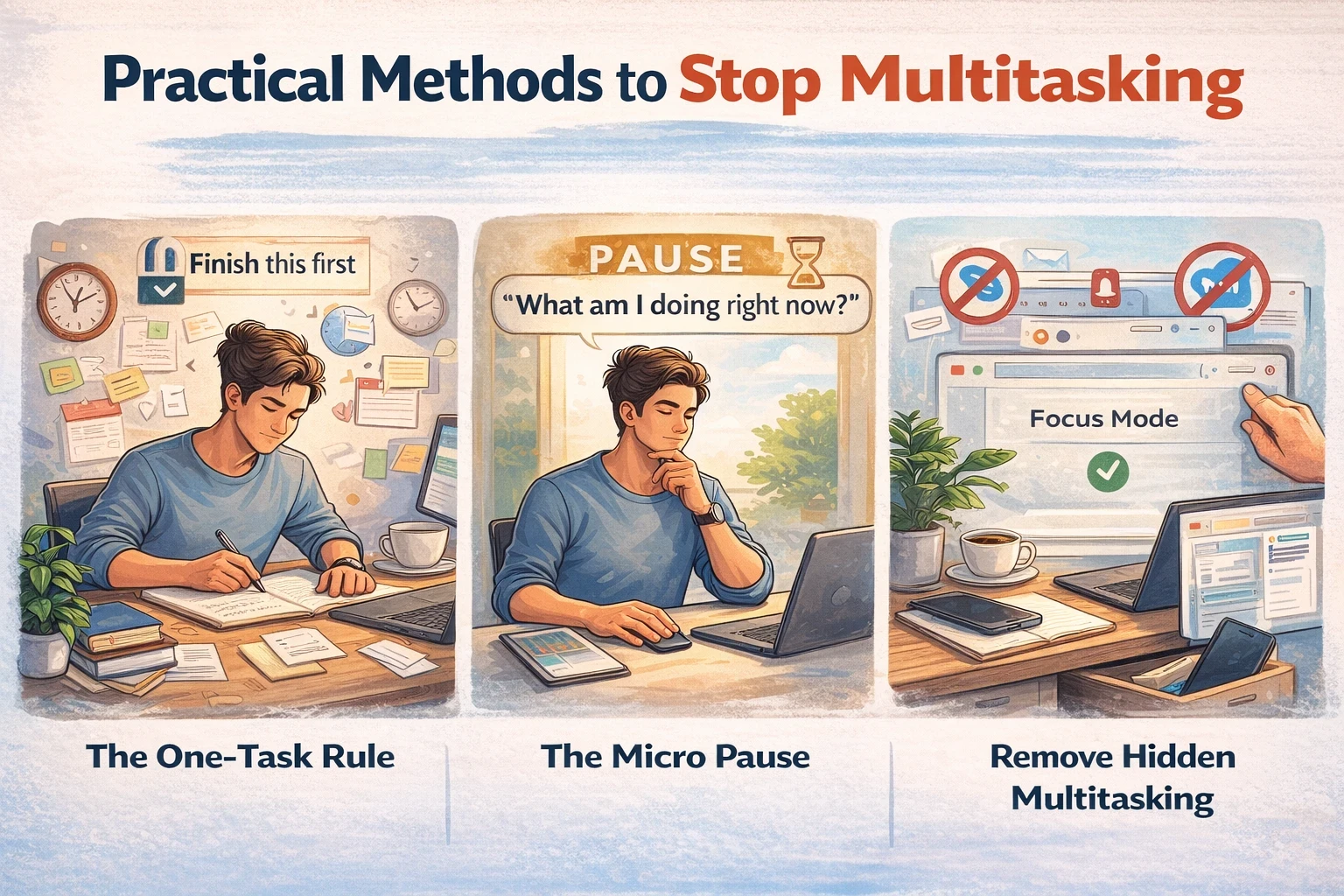
The One-Task Rule
Before starting anything new, either finish the current task or deliberately pause it. No half-finished items drifting around in the background while you work on something else. If you need to stop mid-project, take thirty seconds to jot down exactly where you left off. That brief wrap-up keeps the mental context clear so you can return without losing your place.
The Micro Pause
Before reaching for your phone or opening a new tab, pause for a single breath. Ask yourself: “What am I doing right now?” It sounds almost too simple, but that one-second gap breaks the automatic habit of multitasking before it starts. It resets your attention rather than letting momentum carry you into scattered mode.
Remove Hidden Multitasking
Not all multitasking is obvious. It hides in open browser tabs, background notifications, the chat window that’s always visible, the habit of glancing at email mid-task. Closing tabs you’re not using, silencing notifications during focused work, and keeping your phone physically out of sight during deep work sessions all make a bigger difference than they seem like they should.
Time Blocking for Focus
Set aside short, focused sessions for demanding tasks, typically 25 to 50 minutes. During those blocks, one task only. Anything that surfaces as a distraction goes on a separate list. When the block ends, take a real break, stretch, get water, move around, then either continue or begin a new block. The structure removes the decision fatigue of figuring out what to work on next and makes focused work feel more manageable.
A Self-Check-In During Work
When work starts feeling overwhelming, try pausing and asking: “Who is actually overwhelmed right now? The task, or the mind reacting to it?” It sounds simple, but that small shift creates a bit of distance between you and the frantic, overloaded state. Just noticing “I’m overloaded, I’m trying to do too many things at once” is often enough to interrupt the pattern. You can drop what isn’t necessary and return to what actually matters in the moment.
When Multitasking Is Actually Fine
None of this means multitasking is always a problem. Folding laundry while listening to a podcast is fine. Cooking and having a conversation at the same time is perfectly natural. When one task is routine and largely automatic, pairing it with something else doesn’t really tax your attention.
The issue arises with tasks that require real focus: writing, decision-making, learning something new, doing creative work. That’s where the multitasking myth does the most damage. There’s no need to be rigid about it. Just notice where doing two things at once helps, and where it quietly undermines the thing that matters.
The Real Shift: From Productivity to Clarity
Chasing “more done” doesn’t always lead where you expect. Most people aren’t overwhelmed because they have too much to do. They’re overwhelmed because their attention is scattered across too many things at once. What matters isn’t how many tasks you touched in a day but the depth of attention you brought to what you were working on.
Productivity, at its most useful, isn’t a measure of volume. It’s working with enough clarity that your priorities actually get the attention they deserve, without draining yourself in the process.
When I started focusing on clarity over quantity, the work improved. The days felt less frantic. There were more moments at the end of the afternoon where something had genuinely been done rather than just moved around. If the old way of working just leaves you tired and behind, this shift is worth trying. The goal isn’t to do more. It’s to do what matters with your full attention, and to find that’s usually enough.
Frequently Asked Questions
Does single-tasking mean doing just one thing all day?
Not at all. Single-tasking means focusing on one thing at a time, finishing or deliberately pausing before switching. It’s about intentional transitions, not locking yourself to a single project for hours.
Will I get less done if I stop multitasking?
Most people find they get more done, and at higher quality, when they single-task. The time saved from not constantly switching tasks adds up faster than you’d expect.
Is multitasking ever helpful?
Yes, when one task is automatic and requires little attention, combining it with something else is fine. The key is noticing where the combination helps and where it quietly gets in the way.
How can I build better single-tasking habits at work?
Start with the one-task rule and the micro pause. Block time for your most important priorities first, before the day fills up. Remove background distractions as much as possible. Small adjustments compound quickly.
Wrapping Up
The multitasking myth promises efficiency but delivers fragmentation. Doing less, with full attention, consistently outperforms doing more with a scattered mind. The energy you free up by not constantly switching translates into better work, lower stress, and a workday that actually feels like something was accomplished. If you want to know how to stop multitasking, the answer isn’t willpower.
It’s simply choosing one thing, staying with it, and letting that be enough. Give single-tasking a genuine try for a few days. You might find that doing one thing well is more satisfying than juggling many things poorly. The problem was never that you had too much to do. It’s that your attention was never in one place long enough to matter.
Try This Today
Before you look for another system or productivity hack, try something simpler.
Pick one task today. Just one.
Close everything else. No switching, no checking, no background noise.
Stay with it until it’s done or until you deliberately pause.
That’s it.
You’ll feel the difference almost immediately.
If You Want to Go Deeper
If this idea resonates with you, a few books explore this shift in a much deeper way. Not just productivity, but how attention shapes your entire experience of life.
The Power of Now by Eckhart Tolle
Each of these, in different ways, points to the same truth: doing fewer things, with full attention, changes everything.

Chris is the voice behind Daily Self Wisdom—a site dedicated to practical spirituality and inner clarity. Drawing from teachings like Eckhart Tolle, Ramana Maharshi, and timeless mindfulness traditions, he shares tools to help others live more consciously, one moment at a time.Learn more about Chris →
Leave a Reply