Dhyana Yoga turns up pretty often in conversations about the Bhagavad Gita, and I know a lot of people feel puzzled or even frustrated by the whole idea of meditation. There’s this feeling that you’re supposed to grab your mind by the collar and force it to sit still. If you’ve ever tried that, you know it usually doesn’t work very well. My experience with the Gita showed me something different, but not what I initially expected.
For years, I thought the answer was simply to stop trying. To let everything be. To trust that stillness would arise on its own if I just relaxed enough. That interpretation felt liberating at first, but it didn’t hold up in practice. The mind kept running. Insights flickered and faded. I was missing something.
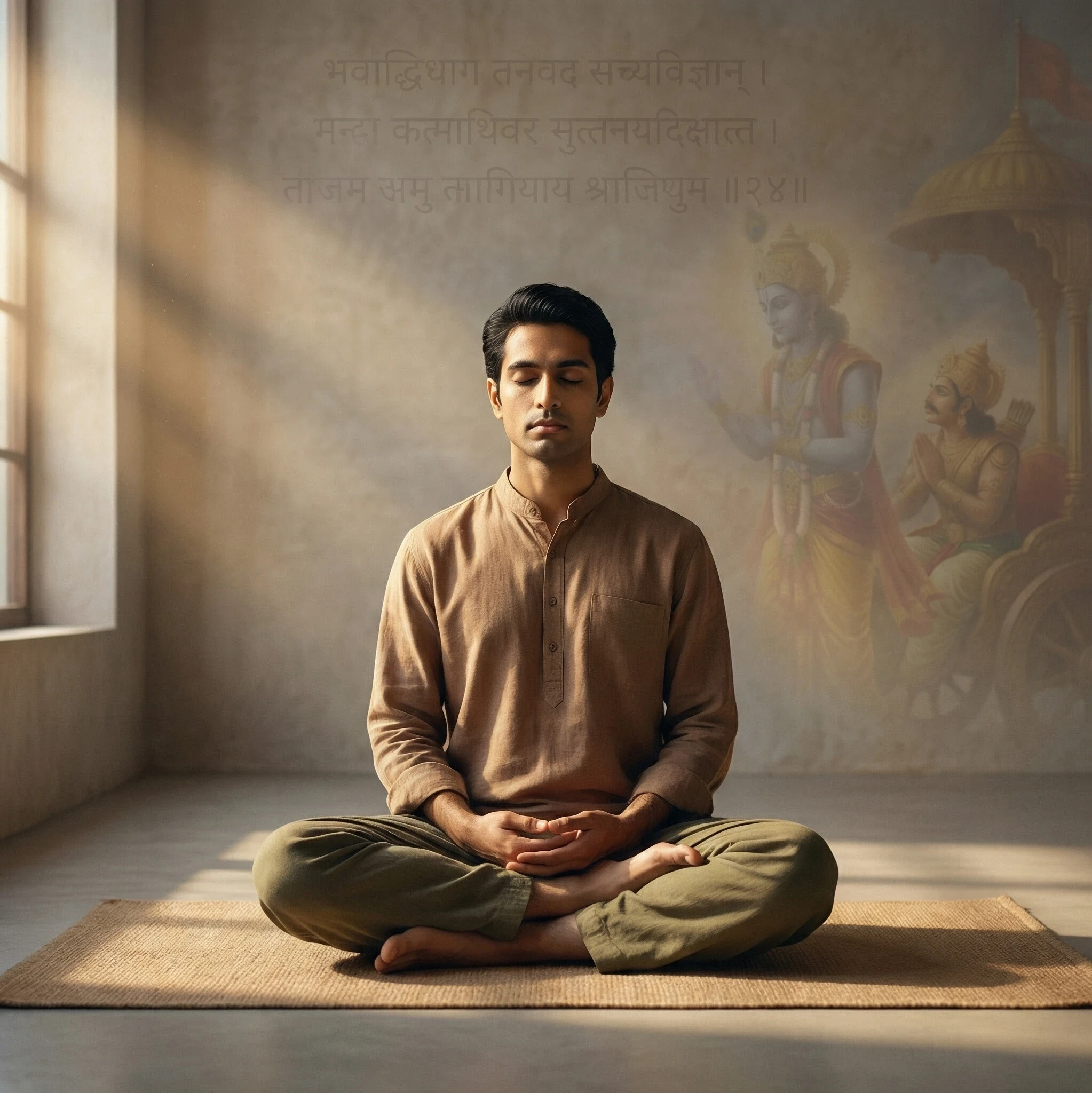
What finally shifted my understanding was reading Chapter 6 more carefully, not through the lens of modern mindfulness, but on its own terms. Krishna doesn’t tell Arjuna to simply relax into presence. He gives specific instructions. He describes a method. And yet, that method isn’t about violence toward the mind. The teaching holds both truths at once: discipline is required, but discipline is not force. Effort exists, but effort is not strain. This paradox confused me for a long time. I want to explain how I came to understand it.
How Dhyana Yoga Is Actually Practiced in the Bhagavad Gita
The Bhagavad Gita doesn’t fence off Dhyana Yoga in a separate corner. Krishna doesn’t show it as a step-by-step, “do-this-and-magic-happens” system isolated from everything else. Instead, Dhyana Yoga emerges from the broader structure of the Gita’s teaching, especially Karma Yoga (selfless action) and the cultivation of discernment through Jnana Yoga.
But here’s what I had wrong for a long time: I thought this integration meant seated meditation was optional. That if I lived attentively enough during the day, formal practice wasn’t necessary. The Gita doesn’t support this reading.
In Chapter 6, verses 11 through 14, Krishna gives concrete, literal instructions. Find a clean, steady seat, not too high, not too low. Sit with the body, head, and neck aligned and still. Fix the gaze. Withdraw the senses. Hold the mind steady on a single point. This is not metaphor. This is not poetry about inner attitudes. Krishna is describing formal seated meditation with specific posture, specific conditions, and specific technique.
Why does this matter? Because the untrained mind cannot sustain clarity. It cannot hold insight. It cannot remain steady when life gets difficult. Dhyana Yoga is the discipline that makes everything else in the Gita possible. Without it, Karma Yoga becomes reactive; you’re still tossed around by preferences and aversions even while doing your duty. Without it, Jnana Yoga remains intellectual; you understand the teaching but can’t embody it when the pressure comes.
Traditional commentators on the Bhagavad Gita have always emphasized this point. Meditation prepares the mind for knowledge. The practitioner sits not to achieve a special state but to make the mind steady enough for understanding to remain. Insight without mental steadiness does not last. This is why Krishna does not skip this step.
Why Krishna Gives Specific Instructions for Dhyana (And Why This Is Not a Contradiction)
This is where most modern readers get confused, and I was among them for a long time. If meditation is ultimately about non-doing, about letting awareness settle naturally, why does Krishna bother with all these instructions about posture and gaze and withdrawal? Doesn’t that contradict the spirit of effortlessness?
The answer took me years to understand: effort and effortlessness are not opposites in the way we usually think. They exist in sequence, not in opposition.
Think of it this way. When you’re learning to drive, everything requires conscious effort. You’re gripping the wheel, checking mirrors constantly, overthinking every lane change. But eventually, driving becomes effortless, not because you stopped making any effort at all, but because the effort became integrated. It no longer feels like strain. The skill matured into ease.
Krishna’s meditation instructions work the same way. The posture, the withdrawal, the repeated returning of attention: these require effort initially. But the effort is not meant to be permanent. It’s meant to train the mind until steadiness becomes natural.
Here’s the key distinction that helped me: discipline is not the same as force. Discipline means showing up consistently, following the method, doing the practice even when you don’t feel like it. Force means fighting the mind as an enemy, clenching against thoughts, straining to achieve silence. Krishna teaches discipline, not force. The approach is firm but not violent. You train the mind the way you would train a horse, with steadiness, patience, and persistence. Not by beating it into submission.
If you skip the discipline and expect the effortlessness to arrive on its own, you’re working against the structure Krishna has laid out. The effortlessness is the fruit of practice, not a shortcut around it.
What “Restraint of the Mind” Actually Means in Chapter 6

This is perhaps the most misunderstood aspect of Dhyana Yoga. When Krishna speaks of restraining the mind, modern readers often hear “suppression.” They imagine pushing thoughts away, blocking mental activity, forcing silence through sheer willpower. If you’ve tried this approach, you know it creates tension rather than peace. The mind gets jumpy. Resistance creates more agitation, not less.
But that’s not what Krishna is describing.
Restraint, in the context of Chapter 6, means something closer to withdrawal of reinforcement. When a thought arises, you don’t feed it. You don’t follow it into its storyline. You don’t argue with it or push it away. You simply don’t add fuel. Without fuel, the thought naturally subsides.
This is different from suppression in a crucial way. Suppression involves active resistance; you’re working against the thought, which actually gives it energy. Restraint involves non-participation; you’re simply not engaging, which allows the thought to lose momentum on its own.
Let me make this more concrete. Say you’re sitting in meditation and a worry about tomorrow arises. The suppressive approach would be: “Stop thinking about that. Don’t think about that. Clear your mind.” You’re fighting the thought directly. The restraint Krishna describes is different: you notice the worry, you recognize you don’t have to follow it into planning and imagining, and you gently return attention to the present. You haven’t forced anything. You’ve simply declined to participate in the elaboration.
Over time, this repeated non-participation has a cumulative effect. The mind loses its compulsive momentum. Thoughts still arise (they always will) but they no longer carry the same charge. They pass through more quickly. Stillness begins to emerge not because you created it, but because you stopped obstructing it.
This is what I missed for years when I thought meditation was about not trying at all. There is something you do: you return attention, again and again, without feeding the distraction. But what you do is gentle, not aggressive. It’s guidance, not domination.
The Central Practice: Verse 6.26 in Context
Verse 6.26 is one of the most quoted instructions in the Gita: “Whenever and wherever the mind wanders, bring it back and place it upon the Self.” This instruction is powerful, but it’s often quoted out of context in a way that distorts its meaning.
Notice where this verse appears. It comes after Krishna has described the seated posture, the withdrawn senses, the fixed attention. This is not a general life instruction disconnected from formal practice. It is guidance for what to do during meditation when distraction arises.
The practice is simple to describe but not easy to sustain. You sit. You settle. The mind wanders (it will, because that’s what minds do). When you notice it has wandered, you bring it back. Not with frustration. Not with self-criticism. Not with dramatic effort. Just a gentle returning, like guiding a child back to a task without scolding.
Then the mind wanders again. And you bring it back again. This is the practice. There is no shortcut. There is no point at which you’ve “done enough returning” and now you can stop. The practice continues, and through that continuation, something changes. The returning becomes easier. The gaps between wandering lengthen. Steadiness begins to emerge as a natural result of this patient, repeated effort.
Arjuna himself admits the difficulty. In verse 34, he says the mind is turbulent, strong, and hard to control, as difficult to restrain as the wind. Krishna does not dismiss this concern. He acknowledges the challenge and then gives the answer: practice and dispassion. Repeated, sustained effort over time, combined with a gradual loosening of the attachment that makes the mind restless in the first place.
The Relationship Between Seated Practice and Daily Life
One of the most important clarifications in Krishna’s teaching is the relationship between formal meditation and everyday living. I used to collapse these into one thing. I thought if I could be mindful while washing dishes or walking to work, that was essentially the same as seated meditation.
Krishna’s teaching corrects this misunderstanding.
Seated meditation is where the training happens. The specific conditions (the stable posture, the withdrawn senses, the protected environment) create a laboratory for working with attention. You can observe the mind more clearly when external demands are reduced. You can practice the return more intensively when you’re not also navigating traffic or responding to emails.
Daily life is where the training reveals its effects. The steadiness cultivated in formal practice begins to show up in ordinary moments: when you’re listening to someone, when you’re facing difficulty, when desires and fears arise. But this is the fruit of meditation, not a replacement for it.
Think of it like athletic training. You practice technique in controlled conditions: the gym, the track, the training field. Then you perform in the game, where conditions are unpredictable and stakes are higher. You cannot skip the training and expect to perform well. In the same way, you cannot skip seated practice and expect steadiness in action.
Some people say, “I meditate while I walk, while I work, while I do daily tasks.” This may be valuable, but it is not what Krishna is describing. He gives specific seated instructions for a reason; the formal posture and withdrawal create conditions that daily activity cannot replicate. “I don’t have time to sit” is the most common objection, and it misses the point entirely. Begin with five minutes. The practice scales, but it must begin.
Over time, if the seated practice matures, the boundaries between meditation and ordinary life do begin to blur. Steadiness becomes less confined to the cushion and more available throughout the day. But this blurring is an outcome of sustained formal practice, not a bypass around it.
The Integration with Karma Yoga and Jnana Yoga
The Bhagavad Gita is not a collection of separate techniques. It’s an integrated teaching where each element supports the others. Understanding how Dhyana Yoga fits into this structure helps clarify what it’s for.
Karma Yoga addresses action. It teaches you to act without attachment to outcomes, to do your duty without being driven by personal desire or aversion. But here’s the practical problem: how do you actually do that when the mind is constantly pulling toward what it wants and pushing away what it fears? A restless, untrained mind cannot sustain non-attachment. It gets swept up in reactions no matter how much you understand the teaching intellectually.
This is where Dhyana Yoga comes in. By steadying the mind through repeated practice, you create the internal conditions where Karma Yoga becomes possible. You’re not suppressing your desires; you’re gradually reducing the compulsive momentum that makes desire so controlling.
Jnana Yoga addresses knowledge, specifically, the understanding of who you really are beyond the body, mind, and personality. But this knowledge has to be more than intellectual agreement. It has to become stable seeing, unshaken by circumstances. And again, the mind must be steady enough to hold that seeing. Insight without mental steadiness flickers and fades. Dhyana prepares the mind so that when understanding arises, it can remain.
The sequence matters. Karma Yoga begins to calm the turbulence created by constant grasping and avoiding. Dhyana Yoga further steadies the mind through formal practice. Jnana Yoga clarifies the fundamental confusion about identity. Each one supports the others. Skipping Dhyana, or treating it as optional or symbolic, weakens the entire structure.
A Practical Guide to Beginning
If you want something like a practical guide to Dhyana Yoga from the Bhagavad Gita, it helps to shift how you think about practice. This isn’t about acquiring a technique that produces results. It’s about showing up consistently and allowing the natural process of settling to unfold.
Start with the conditions. Find a quiet place where you won’t be disturbed. It doesn’t need to be elaborate: a corner of a room, a chair where you can sit comfortably with your spine straight. Krishna mentions keeping the environment clean and simple, not as a rigid rule but as a support for the mind’s settling.
Sit with steadiness. The posture matters not because there’s magic in any particular position but because physical stability supports mental stability. If you’re constantly adjusting or slumping, attention gets pulled into bodily discomfort. Find a position you can maintain without strain.
Fix attention gently. This might be on the breath, on a point in the body, or simply on the sense of being present. The specific object matters less than the quality of attention: steady, relaxed, not grasping.
When the mind wanders (and it will) bring it back without drama. This is the core of the practice. Not preventing wandering, which is impossible, but returning when you notice you’ve wandered. The noticing itself is the practice working. Every return strengthens the capacity for steadiness.
Practice moderation in the rest of your life. Krishna emphasizes this: if you’re exhausted, overeating, or caught in compulsive habits, the mind becomes jumpy. The way you live supports or undermines what happens in formal practice. This doesn’t mean rigid asceticism; it means simple balance. Enough sleep. Reasonable eating. Some space between constant stimulation.
Over time (and this does take time) something shifts. The mind becomes less compulsive. Thoughts lose some of their urgency. A background steadiness begins to pervade experience, even when you’re not formally sitting. This is the fruit of practice. It cannot be forced or rushed.
What This Practice Is Really For
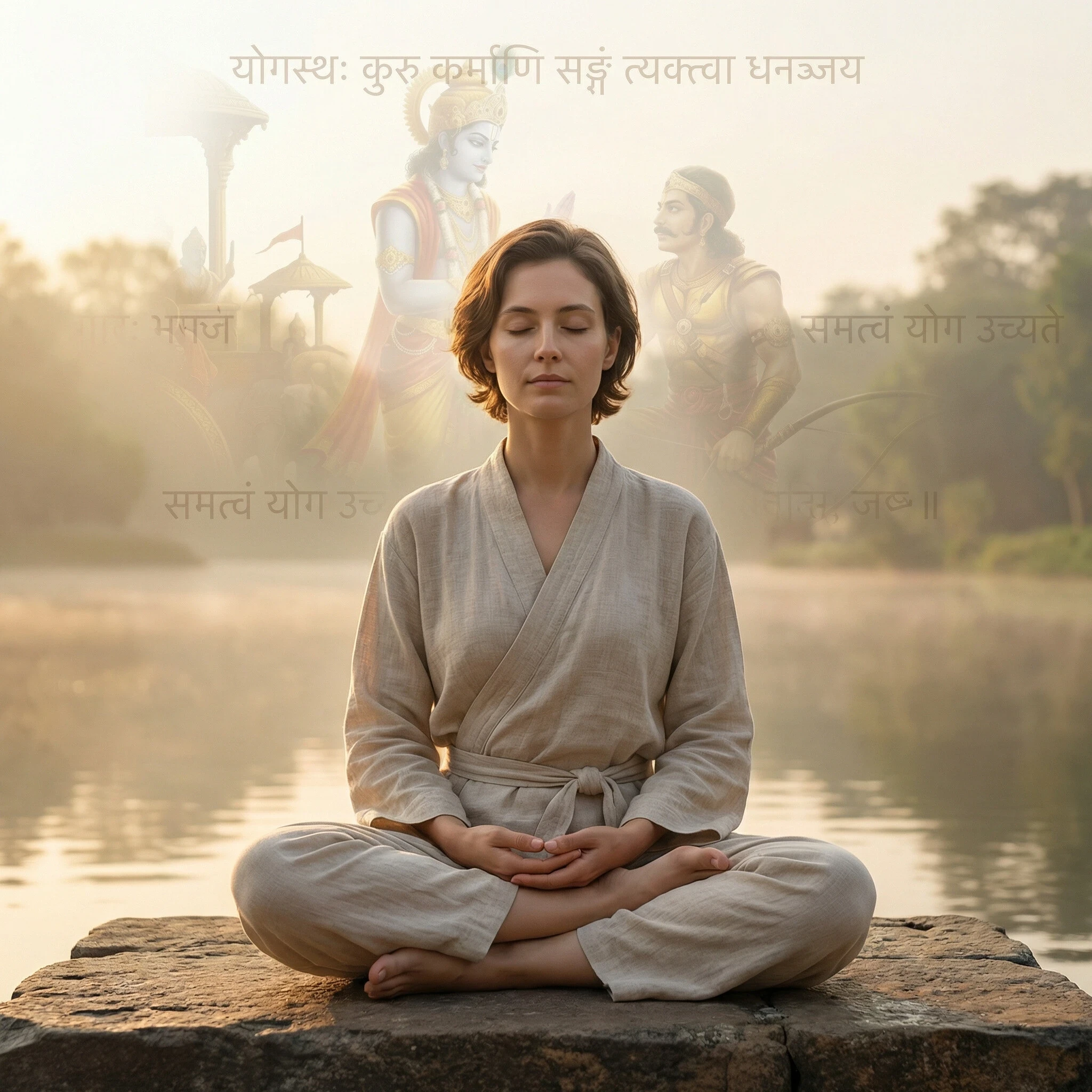
Dhyana Yoga, as Krishna describes it, is not ultimately about achieving a pleasant mental state. It’s about creating the conditions for a deeper recognition: seeing clearly that you are not the body, not the mind, not the personality that seems to be running the show.
The Gita makes this point repeatedly. You are the witness of thoughts, not the thoughts themselves. You are the awareness in which experience appears, not the content of experience. This is not a philosophical position to adopt but something that can be directly seen when the mind becomes still enough to look.
Getting even a taste of this changes the game. You realize that the constant mental chatter is something you witness, not something you are. Emotions arise and pass through; they don’t define you. Even the sense of “me” as the body is seen to be an appearance within awareness, not the awareness itself.
This seeing becomes more stable through continued practice. Dhyana clears the fog so the seeing can occur. Jnana clarifies what is being seen. They work together, circling back to the same home base: unforced, present, and gently attentive.
Wrapping Up
Dhyana Yoga from the Bhagavad Gita is not what modern culture often presents as meditation. It’s not about achieving relaxation, reducing stress, or entering pleasant states, though these may occur along the way. It’s a systematic discipline for steadying the mind so that something deeper can be seen and lived.
If you’ve been feeling like you’re “doing meditation wrong,” take some comfort, but don’t take it as permission to abandon effort entirely. Krishna’s teaching holds a paradox: there is practice, there is discipline, there is effort. But the effort is patient, not aggressive. The discipline is consistent, not violent. And over time, what initially requires deliberate attention becomes natural steadiness.
The Gita’s approach emphasizes allowing rather than forcing, but allowing within a structure of committed practice. The wholesome, balanced life prepares the ground. The seated practice does the specific training. The understanding clarifies identity. Each element holds up the others.
This is not a quick fix. It’s not content to consume. It’s practice translated into living. And it opens, gradually, into genuine stillness and clarity, not as something you achieve but as something you uncover, again and again, by no longer standing in its way.
If you’d like to explore this teaching more directly, you can watch the full video on Dhyana Yoga from the Bhagavad Gita on YouTube or below.

Chris is the voice behind Daily Self Wisdom—a site dedicated to practical spirituality and inner clarity. Drawing from teachings like Eckhart Tolle, Ramana Maharshi, and timeless mindfulness traditions, he shares tools to help others live more consciously, one moment at a time.Learn more about Chris →
Leave a Reply